
Risk-based testing: check your scores against escaped defects
Take a QA lead whose team uses risk-based testing to plan each sprint. Every story gets a risk score, the team tests the high scorers first, and the low scorers…
You have read this


The digital landscape is in constant flux, and at the heart of its reliable evolution lies the critical discipline of software quality assurance. As we navigate the complexities of modern development, marked by rapid releases, intricate systems, and the pervasive influence of artificial intelligence, the very fabric of QA is being redefined as we witness the rise of the hybrid tester. This blog post delves into the state of software quality in 2025, drawing insights from the "4th annual State of Software Quality Report", which surveyed over 1,500 quality engineering professionals to understand the challenges and innovations shaping how organizations achieve quality at scale.
The Rise of the Hybrid Tester
The landscape of software testing is undergoing rapid evolution, and the hybrid tester is at the forefront of this transformation. Unlike their predecessors who specialized in either manual or automated testing, hybrid testers are professionals who seamlessly blend human expertise with AI-driven automation to ensure software quality keeps pace with the demands of modern software development. This isn't merely a change in methodology; it represents a fundamental shift in how testing is managed in an increasingly AI-driven world.
Hybrid testing signifies a move towards strategic quality engineering. In this model, testers leverage AI-powered tools to optimize various aspects of the testing lifecycle, including test creation, execution, and maintenance. Crucially, they also apply their human judgment to validate the tests generated by AI, ensuring that automation efforts are aligned with real user behavior. By entrusting routine tasks to automation and AI, hybrid testers can concentrate on higher-level strategic thinking and ensuring comprehensive test coverage. As organizations relentlessly pursue faster releases and applications of superior quality, the role of the hybrid tester has become indispensable. They act as a crucial bridge between human oversight and machine-driven optimization, guaranteeing that software quality evolves in tandem with AI-accelerated development.
 Source: Katalon
Why Hybrid Testers Matter
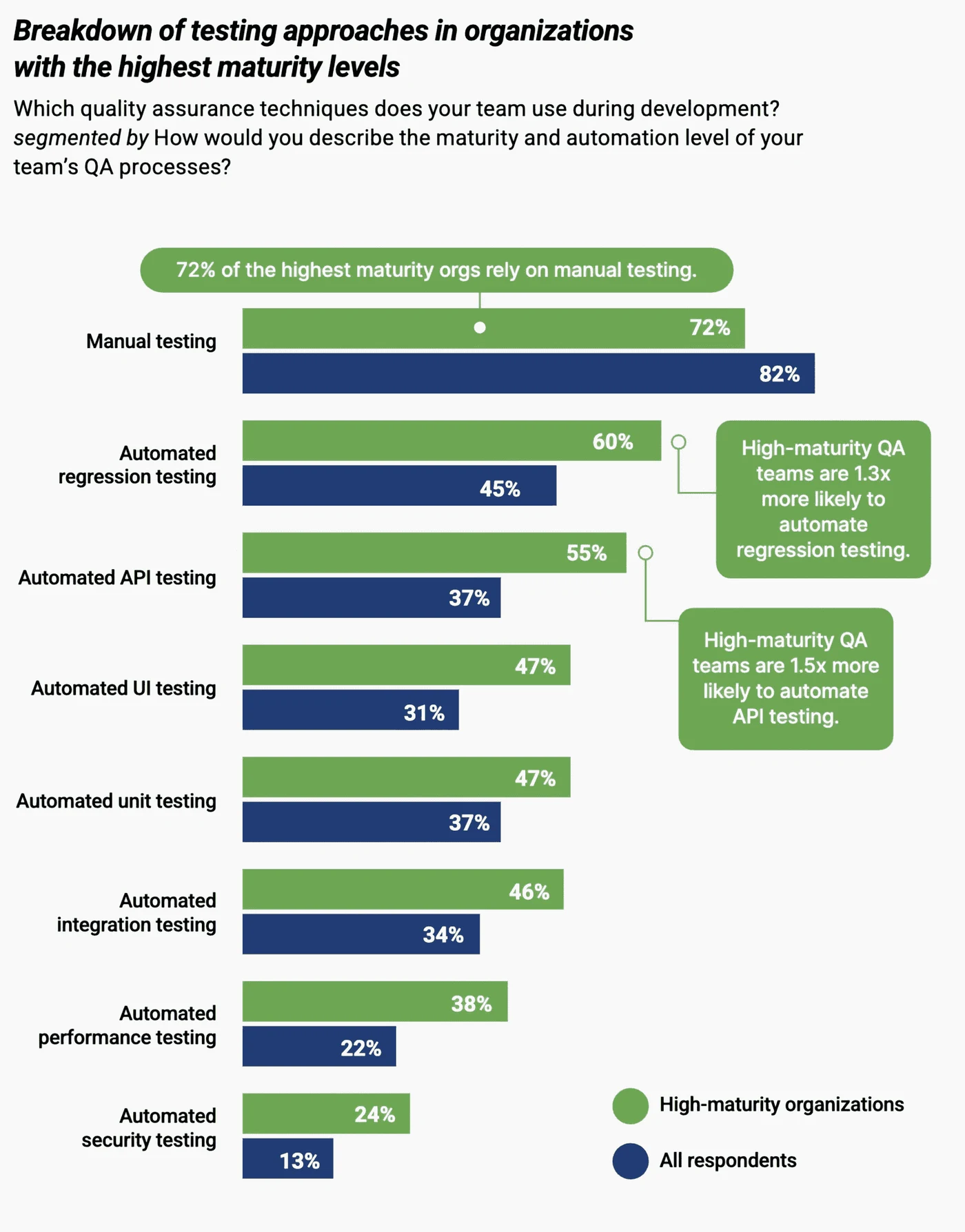
Research indicates that high-maturity QA teams place a strong emphasis on automation. In fact, 45% of these teams implement automated regression testing, and 37% focus on API testing as vital components of their overall testing strategy. This strategic blend of testing approaches empowers hybrid testers to achieve several key objectives: accelerating defect detection, optimizing test coverage, and driving continuous improvement throughout the development lifecycle.
Key Traits of a Hybrid Tester
The success of a hybrid tester hinges on a diverse set of skills and characteristics:
The Hybrid Tester's Competitive Edge
Hybrid testers play a pivotal role in fostering robust communication and seamless collaboration across diverse teams, ensuring that quality remains a central focus throughout the entire development process. The survey data reveals a compelling advantage: high-maturity QA teams that actively leverage hybrid testers are 1.3 times more likely to adopt AI-augmented test optimization and 1.8 times more likely to implement AI-augmented intelligent test maintenance (such as self-healing tests) compared to teams with lower maturity levels. By effectively combining human intuition with the power of automation, these professionals achieve a critical balance between speed, scalability, and unwavering software quality.
The Future of QA is Hybrid
Hybrid testers are not a fleeting trend; they represent the natural evolution of software testing in the modern era. Organizations that strategically invest in these multi-skilled professionals will be significantly better positioned to navigate the inherent complexities of contemporary software development. As the field of software testing continues its dynamic evolution, the role of the hybrid tester will only become more critical. Their ability to seamlessly blend human expertise with cutting-edge automation and AI-powered tools will be the driving force behind future QA success.
Maturity as the Foundation for the Hybrid Tester
It's important to recognize that QA teams exist across a spectrum of maturity levels, and the hybrid tester is uniquely equipped to drive progress at every stage of this journey. For teams in the early stages of QA maturity, hybrid testers play a crucial role in standardizing processes and introducing essential automation practices. Conversely, for more advanced teams, they leverage their strategic thinking and deep technical expertise to implement sophisticated AI tools and continuously enhance improvement efforts. By effectively integrating manual, automated, and AI-driven testing approaches, hybrid testers are pivotal in scaling and optimizing quality assurance initiatives, ultimately empowering teams to advance their maturity levels and effectively meet the ever-increasing demands of modern software development.
The Journey to Maturity
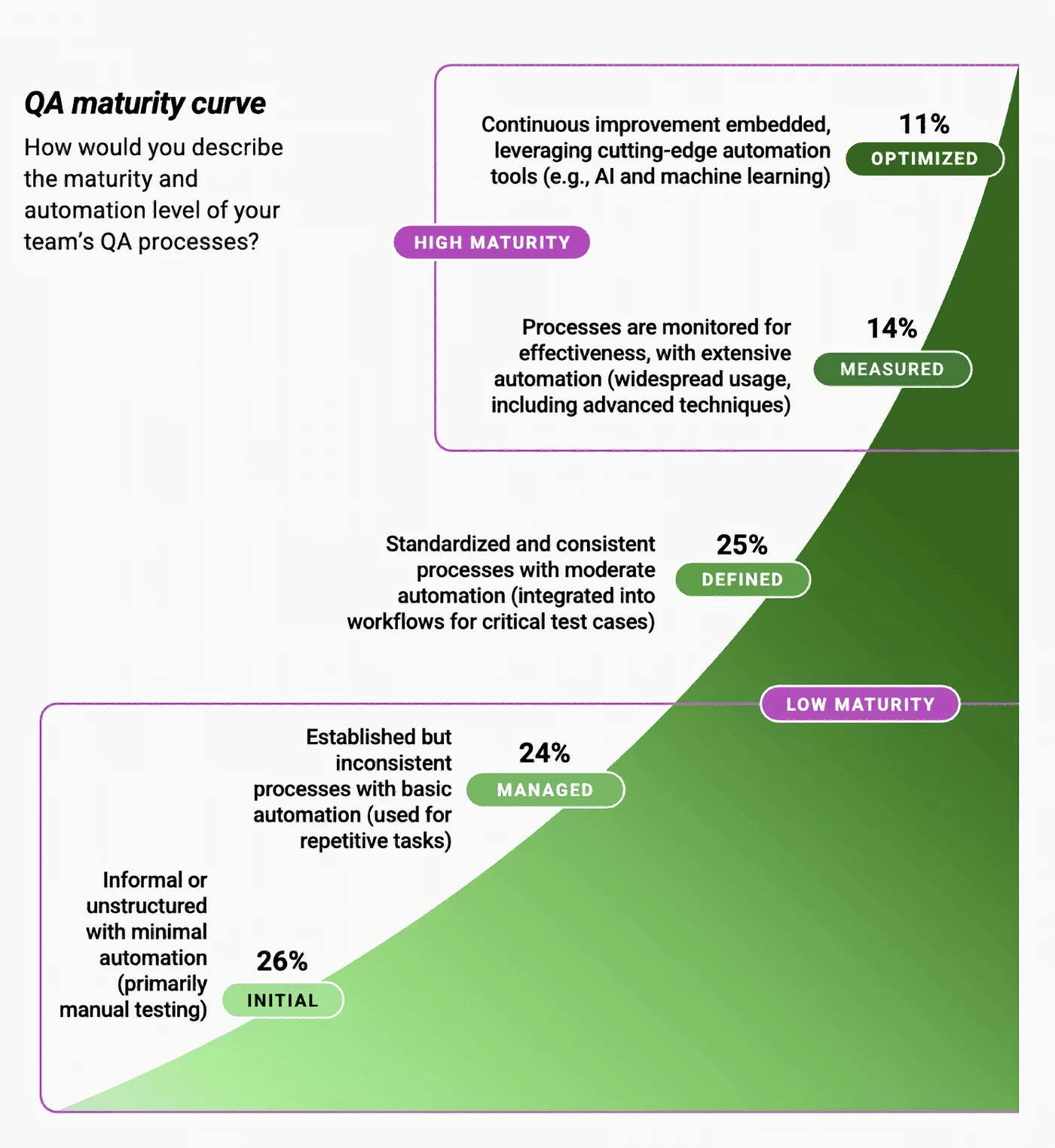
The progression of QA processes lays the groundwork for the ascent of the hybrid tester. The survey data provides a snapshot of the current state of QA maturity across organizations:
Interestingly, larger enterprises (with over 1,000 employees) tend to exhibit more advanced QA maturity compared to the broader industry average. Only 36% of these larger organizations are in the early "Initial" or "Managed" stages, compared to 50% overall. While the largest segment (30%) of large enterprises has achieved standardized processes at the "Defined" level, a substantial 34% have progressed to advanced testing practices, incorporating extensive automation and AI integration. This is notably higher than in smaller companies, where only 20% have reached the highest maturity levels. This data strongly suggests that larger organizations are making significant investments to move beyond traditional manual testing towards more sophisticated and efficient quality assurance approaches.
Why Maturity Matters
The current distribution of QA maturity levels highlights significant opportunities for improvement:
QA Techniques That Define the Hybrid Tester
Hybrid testers are fundamentally changing the approach to software quality assurance by seamlessly integrating a diverse range of techniques to effectively address the demands of modern development. In an environment where organizations are under constant pressure to deliver high-quality software at an accelerated pace, hybrid testers emerge as pivotal figures who can adapt to varying project needs by expertly employing a broad spectrum of methodologies, spanning from traditional manual testing to sophisticated automation strategies.
The Need for Test Diversity
The inherent complexity of modern software necessitates a diverse array of testing techniques to ensure thorough quality assurance. Hybrid testers excel in this dynamic environment by strategically combining the strengths of different methodologies:
 Source: Katalon
The findings of the 2025 survey underscore this emphasis on diversity. While manual testing remains a cornerstone of QA, utilized by 82% of all respondents, automation has become increasingly indispensable for achieving both efficiency and comprehensive coverage. Techniques such as automated regression testing (45%), automated API testing (37%), and automated unit testing (37%) are now integral components of mature QA processes. Furthermore, exploratory testing, highly valued for its ability to uncover unique and unexpected issues, ranks high at 44%, highlighting the crucial balance that hybrid testers bring to their testing workflows.
Interestingly, organizations that have reached the "Measured" and "Optimized" maturity levels (representing 33% of the surveyed organizations) exhibit distinct testing patterns. These organizations, characterized by rigorously monitored processes, extensive adoption of advanced automation, and a strong commitment to continuous improvement, are 1.5 times more likely to utilize automated API testing and 1.5 times more likely to implement automated UI testing, while concurrently reducing their reliance on traditional manual testing compared to industry averages. This data clearly indicates a significant shift towards comprehensive automation across both the service and user interface layers in higher-maturity teams.
This inherent diversity in their technical toolkit enables hybrid testers to adapt effectively to the varying requirements of different projects, ensuring a robust and flexible approach to quality assurance.
The Skills That Set Hybrid Testers Apart
Hybrid testers form the very backbone of modern QA teams, seamlessly blending crucial technical expertise with essential soft skills that render them indispensable to successful software development. As the demands placed on software quality continue to evolve at an accelerated pace, hybrid testers distinguish themselves through their remarkable adaptability, their collaborative spirit, and their adeptness at leveraging cutting-edge tools to effectively tackle a wide range of diverse challenges.
The 2025 survey results shed light on the skills that QA professionals themselves identify as most critical in today's environment. Automation scripting and programming skills top the list, valued by 68% of testing teams, underscoring the fundamental role that automation now plays in contemporary workflows. API and web services testing follows closely at 43%, reflecting the increasing prevalence of microservices and interconnected systems in modern software architectures. However, the importance of technical prowess is balanced by the critical need for strong problem-solving and analytical skills (42%), which empower hybrid testers to effectively pinpoint root causes and address complex issues head-on.
Interestingly, the research reveals that hybrid testers are 1.4 times more likely to prioritize AI and machine learning in QA but are 24% less likely to emphasize meticulous attention to detail compared to the average QA professional. This shift indicates a growing reliance on AI technologies for tasks such as test maintenance, optimization, and defect detection—tasks that were previously heavily dependent on painstaking manual scrutiny. By automating detailed analysis, hybrid testers can strategically redirect their focus towards higher-level problem-solving and strategic planning, reflecting a broader industry trend where proficiency in AI is becoming increasingly critical, often surpassing the need for exceptionally detailed manual verification.
The Hybrid Tester's Strengths
Hybrid testers thrive in dynamic and fast-paced environments, effortlessly adapting to evolving technologies and shifting project needs. Their expertise extends far beyond the boundaries of traditional testing roles, encompassing a powerful combination of deep technical proficiency, strategic thinking capabilities, and strong cross-team collaboration skills. Key strengths include:
By effectively leveraging these core strengths, hybrid testers drive innovation within Agile and DevOps ecosystems, ensuring that software quality keeps pace with the relentless demands of modern development.
The Time-Saving Advantage of Hybrid Testing
In the realm of modern software development, time is an invaluable asset, and hybrid testers are proving to be exceptional optimizers of this crucial resource. By strategically integrating AI-powered tools with traditional testing methodologies, they streamline testing processes, significantly elevate QA quality, and ensure thorough test coverage.
 Source: Katalon
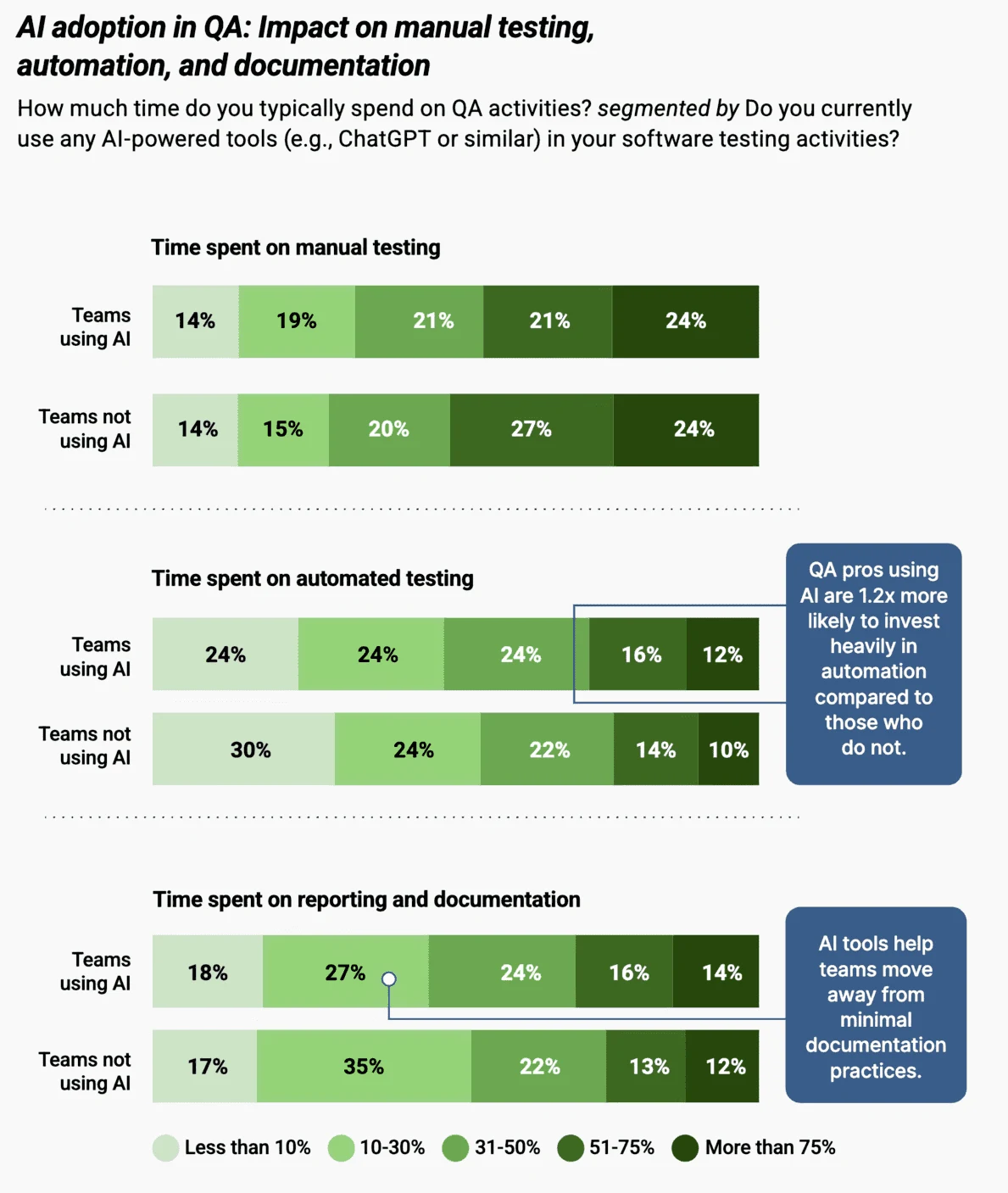
The survey data highlights significant distinctions between teams that have embraced AI in their QA activities and those that have not. While both groups tend to spend a comparable amount of time on manual testing, AI-driven teams are 1.2 times more likely to invest heavily in automation (with 28% dedicating more than half of their time to it, compared to 24% for non-AI teams). Furthermore, they are also 1.2 times more likely to allocate more time to reporting and documentation (with 30% dedicating over 30% of their time to it, compared to 25% for non-AI teams).
The most striking difference emerges in the distribution of documentation efforts. Teams utilizing AI exhibit a more balanced distribution of time spent on documentation across various ranges, whereas non-AI teams tend to concentrate their documentation efforts (35%) in the lower 10-30% range. This suggests that AI tools are playing a significant role in helping teams move away from minimal documentation practices towards a more comprehensive and evenly distributed approach.
The key contrast is clear: teams that do not leverage AI tend to cluster their documentation time in the low-effort range, while AI users distribute their documentation work more evenly across all time ranges, potentially indicating that AI tools are making thorough documentation more achievable and less burdensome. AI tools help teams move away from minimal documentation practices. Furthermore, QA pros using AI are 1.2x more likely to invest heavily in automation compared to those who do not.
Hybrid testers are not simply automating tasks; they are fundamentally reshaping how QA time is strategically invested. They are facilitating a transition from sporadic, manual-heavy workflows to systematic and comprehensive testing approaches through the effective leverage of AI. The tangible result is more thorough test coverage achieved with a more balanced allocation of effort, enabling QA teams to effectively meet the intense demands of modern software development without having to compromise on either quality or essential documentation. This strategic reallocation of time is what makes hybrid testers such an invaluable asset in today's rapidly evolving development landscape.
The Role of AI in Transforming Software Testing
The impact of Artificial Intelligence on software testing is a central theme of the report. A significant 82% of respondents believe that AI is critical to the future of testing. As discussed earlier in the context of hybrid testers, AI is playing an increasingly significant role in optimizing various aspects of the testing lifecycle, from test generation and execution to intelligent test maintenance. The shift towards prioritizing AI proficiency over meticulous manual verification signifies a fundamental change in the skills and focus required for success in modern QA.
In today's fast-paced development cycles, achieving a delicate balance between the need for speed and the imperative for high quality is paramount. High-maturity QA teams are effectively navigating this challenge by making smart use of continuous testing (40%) and CI/CD integration (48%). These practices enable teams to deliver software faster without sacrificing reliability, embedding quality checks throughout the development pipeline rather than treating testing as a separate, downstream activity.
Quality assurance is no longer just a cost center but a strategic driver of business success. Organizations that prioritize QA maturity, the strategic adoption of automation, and the intelligent integration of AI are reaping significant business benefits. These high-performing organizations report 32% higher customer satisfaction, 24% lower operational costs, and 11% faster time to market. This data definitively demonstrates the tangible return on investment in building a mature and forward-thinking QA function.
As organizations strive for faster, higher-quality releases, the ability to seamlessly blend human expertise with the power of intelligent automation will be the defining characteristic of successful QA teams. By embracing the hybrid revolution and prioritizing QA maturity, businesses can transform quality assurance from a necessary cost into a powerful strategic advantage, driving customer satisfaction, reducing operational expenses, and accelerating their time to market. The future of software quality is not just about testing; it's about engineering quality into every stage of the development lifecycle, and the hybrid tester is leading the charge.
Take a QA lead whose team uses risk-based testing to plan each sprint. Every story gets a risk score, the team tests the high scorers first, and the low scorers…
You have read this