Take a QA lead whose team is tired of flaky Selenium runs. At the planning meeting, someone proposes moving the checkout tests from Selenium to Playwright. The reason given is that Playwright waits for elements on its own. Nobody in the room has read the list of recent failures. A new tool can only remove the failure causes it controls, so sort the recent failed runs by cause before you choose.
What TestDevLab says auto-waiting does and does not fix
TestDevLab, a company that sells test automation services, published "Playwright vs Selenium: Which to Choose in 2027" on November 4, 2026. It is vendor writing, and it ends sections with a pitch for those services. It recommends Playwright as the stronger start for a new web suite. It says Selenium fits better where a team needs more languages, browsers or mobile devices.
A flaky test sometimes passes and sometimes fails on the same code. The article names the usual cause: "Most flaky UI tests come from timing, meaning a test acts on an element before the page is ready". Playwright has auto-waiting, which means it waits until an element on the page is ready before it clicks or types. The article says auto-waiting cuts timing failures. It then gives a limit: "Auto-waiting does not fix everything".
The article also names three causes that stay whichever tool a team uses. In its words, "Shared test data, unstable environments, and tests that depend on each other cause failures in either tool".
Shared test data: anything that more than one test uses, such as one customer account that two tests both change.
Unstable environments: test servers, or test copies of other services, that sometimes run slowly or fail for reasons that have nothing to do with the code. A payment sandbox, a test copy of a payment service, is one example.
Tests that depend on each other: a test that passes only when another test has already run and left the right data behind.
The article reports no measurements of its own. Its statements about speed describe what many teams find, and its comparison tables are the vendor's summary.
How to give a failed run one cause
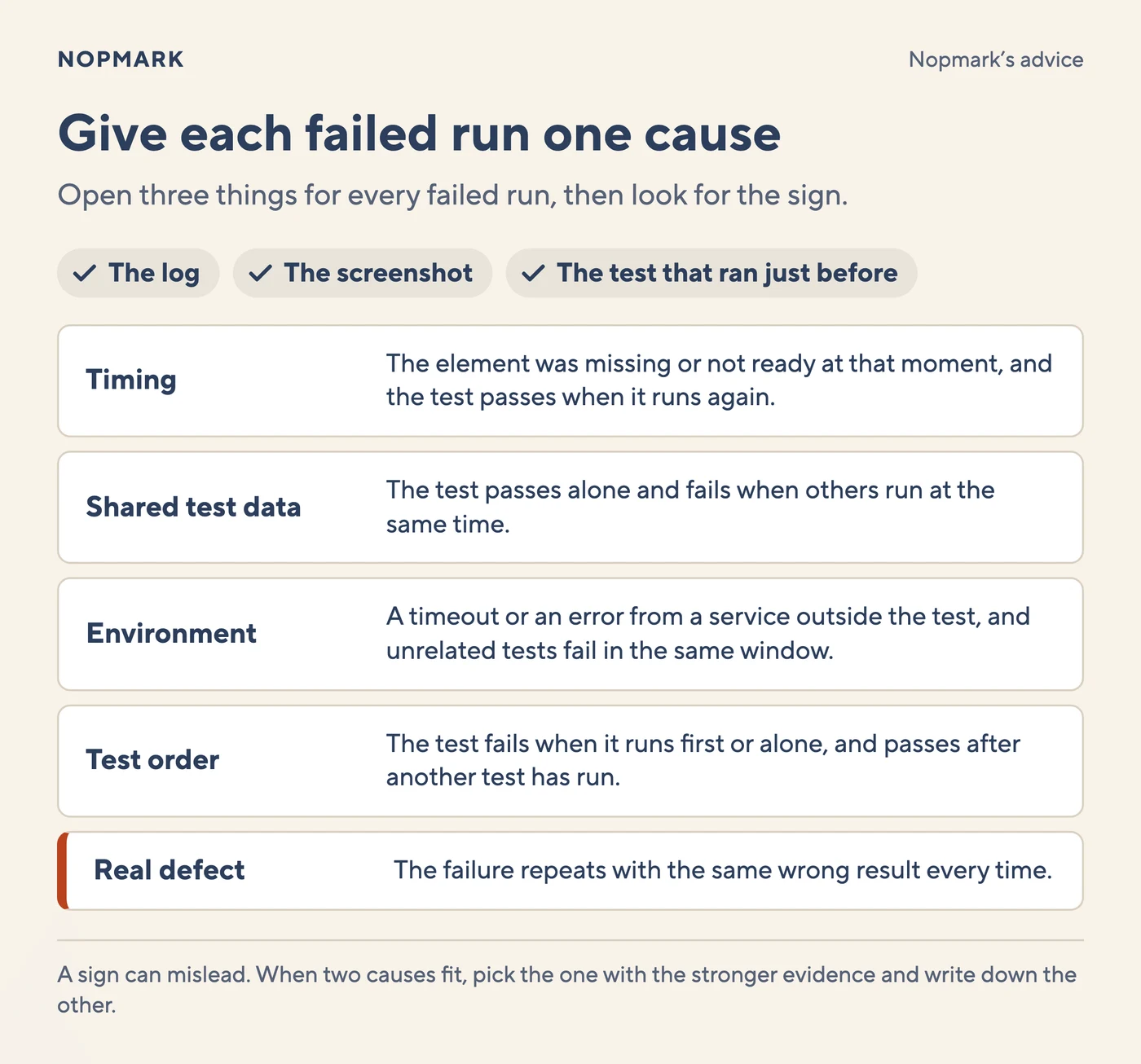
For each failed run, a tester needs the log, the screenshot and the name of the test that ran just before. With those, a few signs usually point to the cause.
Timing: the log shows the element was missing or not ready at that moment, and the test passes when it runs again.
Shared test data: the test passes alone and fails when others run at the same time, or the data it reads was changed by another test.
Environment: the log shows a timeout or an error from a service outside the test, and several unrelated tests fail in the same window.
Test order: the test fails when it runs first or alone, and passes after another test has run. It may also fail when the order changes, because an earlier test no longer leaves the data it needs.
Real defect: the failure repeats with the same wrong result every time.
A sign can mislead, so when two labels fit, the tester picks the one with the stronger evidence and writes down the other. This method is Nopmark's advice and does not come from the article.
Reading 40 failed runs
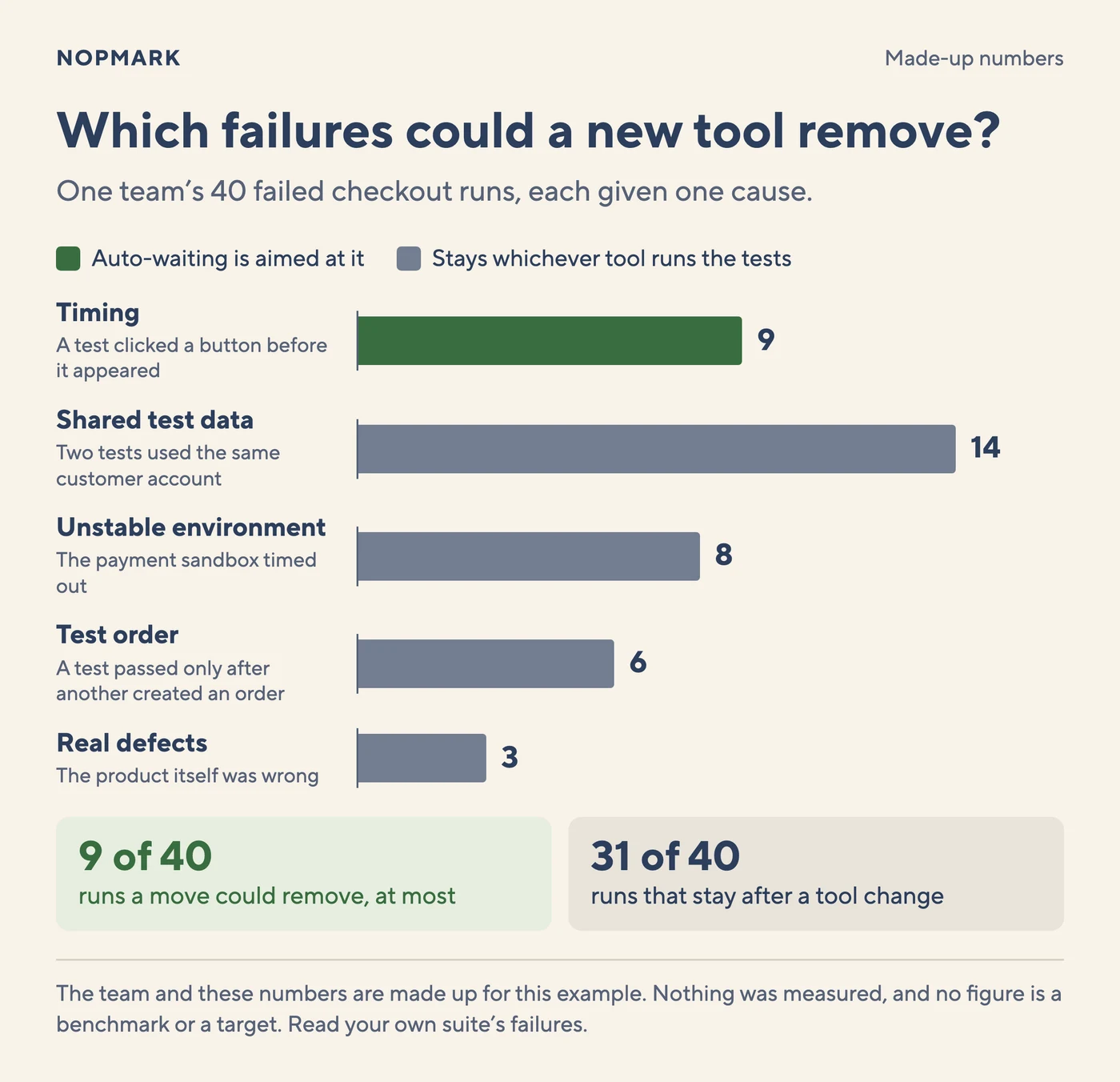
Say a team with a Selenium suite for its checkout has 40 failed CI runs from the last few weeks. CI, short for continuous integration, is the automated system that runs the tests whenever someone changes the code. A tester opens each failed run and gives it one cause. Say the tally comes out like this.
Timing, 9 runs: a test clicked a button before it appeared.
Shared test data, 14 runs: two tests used the same customer account.
Unstable environment, 8 runs: the payment sandbox timed out.
Test order, 6 runs: a test passed only after another test had created an order.
Real defects, 3 runs: the product itself was wrong.
The team and these numbers are made up for this example. Nothing was measured, and no figure here is a benchmark or a target. Your own suite's failures are the ones to read, however many there are.
Would moving from Selenium to Playwright remove these causes?
Go down the tally and ask of each cause: does the tool control it? Auto-waiting is aimed at the 9 timing failures. The other 31 runs come from a shared account, a sandbox that times out, a test that needs an order another test creates, and 3 genuine defects. A new tool leaves all of those in place, because they come from the test data, the environment, the order of the tests and the product.
The article says most flaky UI tests come from timing. It gives no figure for any one suite. A team can use the tally to check whether that is true for its own failures. Here, timing is 9 runs out of 40, so a move could remove at most those 9. That limit is my reading of the article's point. It is not a TestDevLab finding.
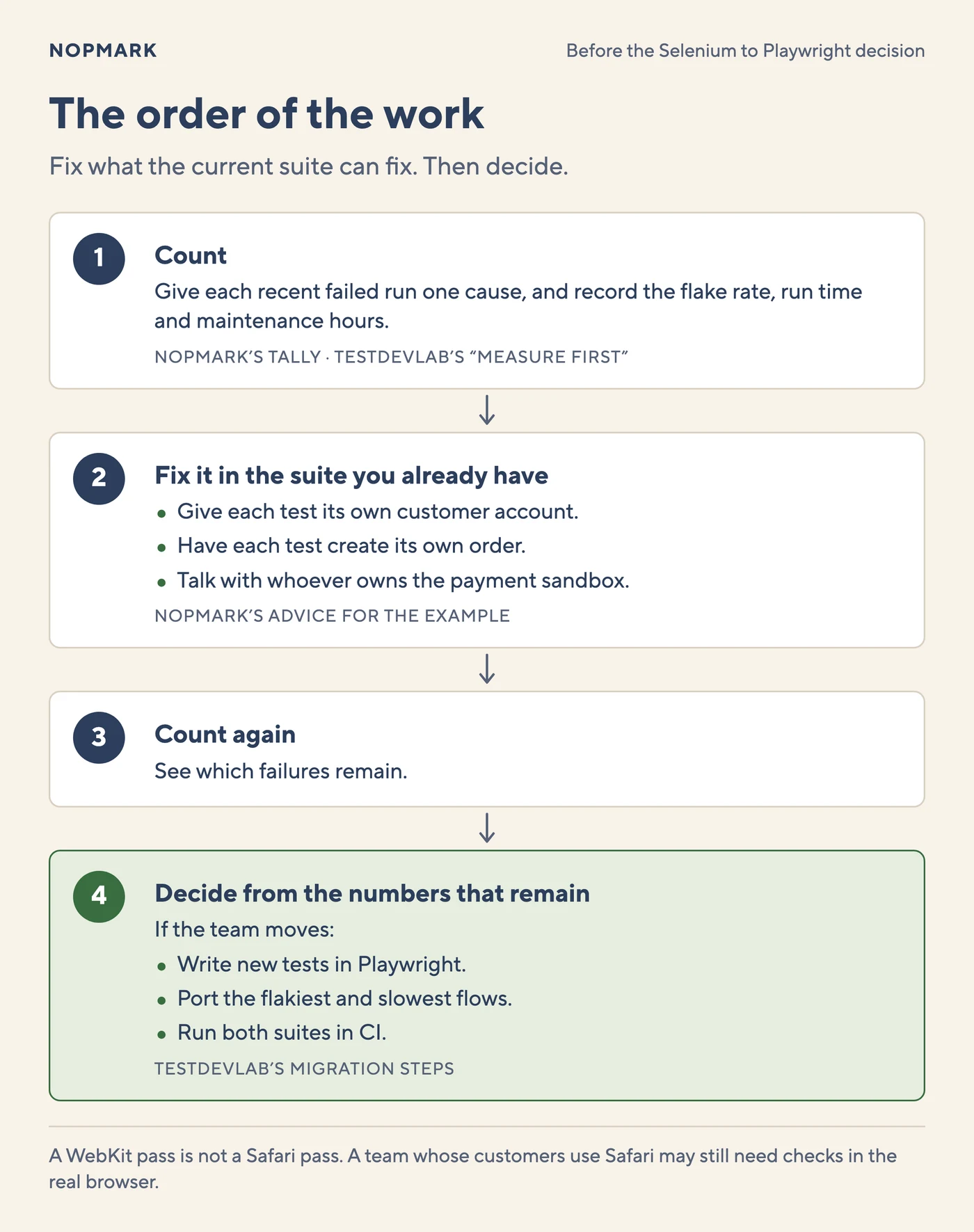
The team can fix the rest with the Selenium suite it already has. Giving each test its own customer account would remove the shared data. Having each test create its own order would remove the order dependency. The team needs to talk with whoever owns the payment sandbox. After those changes, the lead counts the failures again, and the team decides about moving from the numbers that remain.
My view as an instructor is that Selenium has a long history and a very large ecosystem of plug-ins and tools. I also think Playwright is the more modern tool, with faster runs, easier maintenance and parallel test runs built in. That is an opinion, not a measurement. It is a fair reason to consider the move, and it does not replace the count.
The order of the work
The tally adds a cause to each failure in the article's first migration step. The article says, "Measure first. Record the flake rate, run time, and maintenance hours of your Selenium suite, so you can judge the move later". The flake rate is the share of runs that fail for a reason other than a real defect. Run time is how long a full run takes, and maintenance hours are the hours the team spends repairing tests. Recorded before the move, these give the team numbers to compare with afterwards.
If the team does move, the article recommends writing new tests in Playwright, porting the flakiest and slowest flows, and running both suites in CI. Running both on the same changes lets the team compare their results directly. The article also tells readers to "benchmark a representative slice of your own suite before you decide".
A caution about WebKit and Safari
The article adds a warning for teams that test in WebKit, which is the browser engine behind Safari. It says, "WebKit is the engine behind Safari, but it is not Safari, so some issues that only appear in the real browser on macOS or iOS can slip past". A team whose customers use Safari may therefore still need checks in the real browser, whichever tool runs the rest.
What the lead takes back to the meeting
When the lead brings the tally to the next meeting, it shows that auto-waiting would address 9 of the 40 failures. The shared account and the order dependency can be fixed first, in the suite the team already runs. The team can also talk with the sandbox owner. Once those are done, the team counts again and makes the decision about moving with the failures that remain.
A team that is weighing a tool change, or is tired of flaky runs, can start a training-needs conversation with Nopmark through the contact page.
Questions about moving from Selenium to Playwright
What is a flaky test? It is a test that sometimes passes and sometimes fails on the same code. Common causes include timing, shared test data, an unstable environment and tests that depend on each other.
Does auto-waiting remove flaky tests? It cuts failures caused by timing, because the tool waits until an element is ready. TestDevLab's article says most flaky UI tests come from timing. It gives no figure for any one suite. It also says auto-waiting does not fix everything. It names shared test data, unstable environments and dependent tests as causes in either tool.
What should a team record before moving from Selenium to Playwright? The article says to record the flake rate, run time and maintenance hours of the Selenium suite. This post adds one step: give each recent failed run a cause, so the team can see which causes a new tool could remove.
Is a WebKit pass the same as a Safari pass? No. The article says WebKit is the engine behind Safari but is not Safari, so some issues that appear only in the real browser on macOS or iOS can slip past.
Sources
TestDevLab, "Playwright vs Selenium: Which to Choose in 2027", published November 4, 2026. Source for every quoted line, the recommendation summary and the migration steps. TestDevLab sells test automation services, and the article is vendor editorial with no measurements of its own.
In December 2023, a Chevrolet dealer in Watsonville, California, had a chatbot on its website. Jalopnik reported on December 19, 2023 that a visitor gave the bot new orders. Every…