
Risk-based testing: check your scores against escaped defects
Take a QA lead whose team uses risk-based testing to plan each sprint. Every story gets a risk score, the team tests the high scorers first, and the low scorers…
You have read this


The world of software testing is in constant flux. The rise of AI-driven automation, the deepening integration of DevSecOps, and the increasing complexity of distributed systems are not just buzzwords—they are the reality shaping the software testing trends 2025 and beyond. While staying current with new tools and technologies is vital, it's only half the battle. The other half? Mastering the timeless, human-centric skills that make a good tester truly great.
So, what do hiring managers really look for when they want to build a resilient, effective, and future-ready QA team? A white paper by the American Software Testing Qualifications Board (ASTQB), authored by veteran manager Judy McKay, lays it out perfectly. It’s not just about what you know, but how you apply it, how you communicate it, and how you grow with it.
This guide distills those core insights and expands on them for mid-level professionals looking to accelerate their software testing career growth. If you’re aiming for a senior role or seeking to establish yourself in QA team leadership, mastering these seven characteristics is your roadmap to success.
Competence is more than just knowing testing theory; it's the ability to apply your knowledge across diverse and challenging situations. It’s about being a multifaceted professional who blends testing expertise with skills in project management, business analysis, and even development. In today's environment, being effective means leveraging every piece of your experience to fit the unique context of a project.
The key to deep and lasting competence is a commitment to continuous learning. Technology will not wait for you, and a manager isn't always going to arrange a training session. True competence comes from self-directed learning:
Actively seek knowledge: Read industry articles, attend webinars, and engage with peers at conferences or online forums.
Challenge complacency: If you've been at one company for a long time, it's easy to get comfortable. You must actively look outside your bubble to understand what's new, what's effective, and what's just hype. Bring these ideas back to your manager; they are likely struggling to keep up, too.
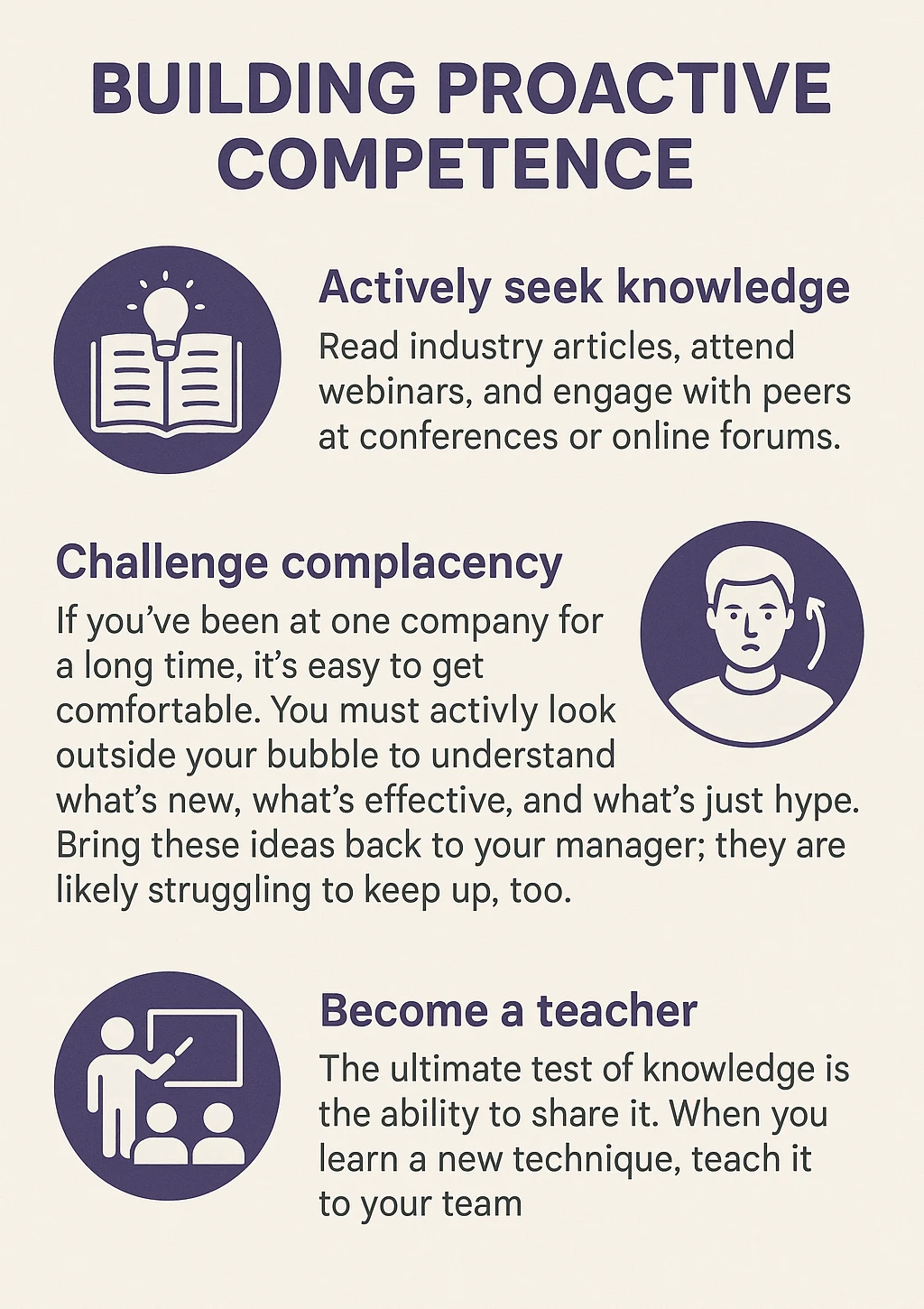
Become a teacher: The ultimate test of knowledge is the ability to share it. When you learn a new technique, teach it to your team. Show developers and business analysts how to use decision tables to clarify requirements. This not only solidifies your own understanding but also positions you as a leader.
From the Manager's Desk: "Being a good tester is not just about knowing how to test, but also how to be effective in an environment. This requires leveraging everything you've learned and applying it to the current situation or project."
Communication is consistently listed as an area for improvement on performance reviews, but what does "good" communication actually mean in a testing context? It boils down to two critical, and sometimes contradictory, skills: knowing when to raise an issue and knowing when to be quiet.
Your manager depends on you to be the eyes and ears of the project. You have a responsibility to raise important risks and issues, not to assume someone else has already seen them. A project has "symptoms" just like a patient, and they must be reported to be addressed.
However, there's a fine line between flagging a risk and complaining. Once an issue, like a tight schedule, is known and a decision has been made, constantly nagging about it doesn't help. Raise the issue, ensure it's understood, and then focus on executing your job to the best of your ability within the given constraints. This is what separates a problem-solver from part of the problem.
Finally, good communication involves knowing the right audience. A sensitive issue might be better raised by your manager than directly with a touchy stakeholder. When in doubt, ask your manager first.
And a simple pro-tip: if you're asked for a weekly status report, do it promptly and in the requested format. This is a simple, low-effort way to keep your manager informed of your excellent work and make their life easier—a guaranteed way to stay in their good graces.
Independence is a sign of growth and readiness for more responsibility, making it a key trait for
QA team leadership. Managers want to see you take the initiative to handle problems on your own. However, too much independence can backfire. If you've ever been asked, "Why didn't you tell me sooner?", you may have crossed the line.
The ideal balance is to handle what you can while keeping your manager informed. A quick message like, "FYI, I'm looking into a performance issue with the new API. I'm starting with X and Y and will let you know what I find," is perfect.
This approach achieves two things:
It provides visibility: Your manager is aware of the issue and knows you're on top of it. The problem you see might be a symptom of a larger issue they need to address at a higher level.
It invites guidance: It gives your manager a chance to offer advice, provide air cover, or redirect your efforts before you get too deep.
Case in Point: McKay gives an example of a tester who dealt professionally with a rude development manager while keeping her informed. The tester avoided open conflict, which allowed the management team time to handle the personnel issue properly, all while providing the necessary information behind the scenes. This built immense respect and trust.
In a technical field, mistakes happen. You will delete the wrong database, run a performance test against production, or misunderstand a requirement. It’s part of learning and growing. What defines your professional character is what you do next.
A good manager needs and expects honesty. Hiding a mistake is almost always worse than the mistake itself. Your manager is on your side and is there to help you figure out how to fix the problem. Admitting an error builds trust and allows for a quick, collaborative recovery.
Think of honesty as your career insurance. You will eventually make a mistake, so ensure your intentions are always good, as you will need to ask for forgiveness and help.
The best testers are fueled by curiosity. They see each new project not as a burden, but as an adventure—a new world to explore, understand, and, yes, break. This intrinsic motivation is far more powerful than any external reward.
If you find joy in uncovering a complex bug or collaborating with a team to improve quality, you will find it easy to stay engaged. This sense of adventure is also what will carry you through the more monotonous parts of the job. Let's be honest—writing test cases and executing regression suites can be a slog.
But it's a package deal. The frustration of a last-minute bug is balanced by the reward of seeing a product improve because of your work. Self-motivated people are happier and more effective because they know when they're doing good work; they don't need a manager to tell them.
If there is one skill that directly correlates with the software testing trends 2025, it's adaptability. Managers treasure testers who can move between projects, learn new technologies, and adapt to different methodologies without missing a beat.
The more comfortable you are with different lifecycle models (Agile, Waterfall, DevOps), technologies, and tools, the more valuable you become. Can you write manual scripts and contribute to an automation framework? Can you pivot from testing a mobile app to a back-end microservice?
This flexibility is critical. You will never know everything you need to know on day one of a new project. Success depends on your ability to adapt and learn while navigating that initial period of discomfort. If you see that challenge as an opportunity, you will thrive in any modern testing organization and be highly attractive to hiring managers.
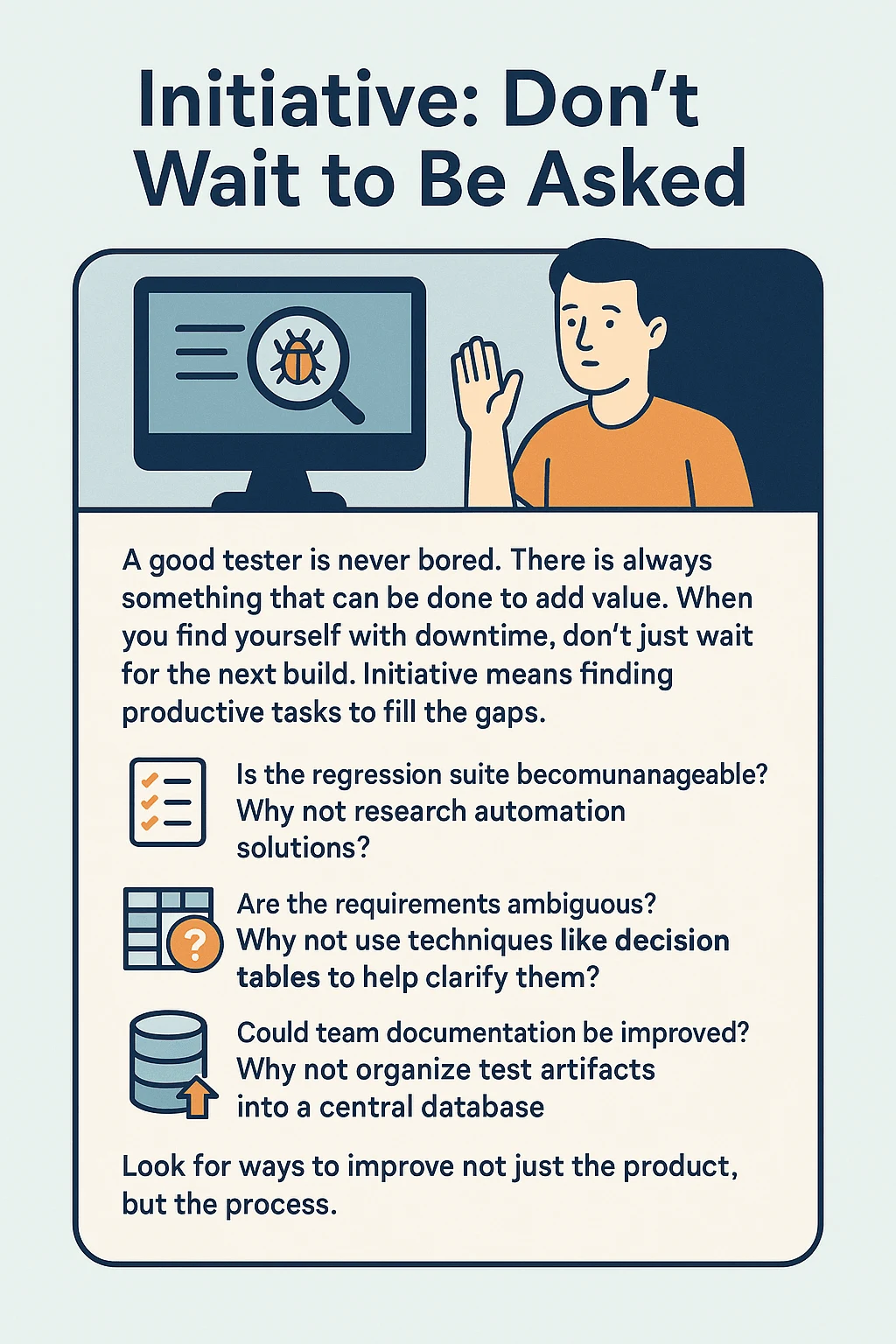
A good tester is never bored. There is always something that can be done to add value. When you find yourself with downtime, don't just wait for the next build. Initiative means finding productive tasks to fill the gaps.
Is the regression suite becoming unmanageable? Why not research automation solutions?
Are the requirements ambiguous? Why not use techniques like decision tables to help clarify them?
Could team documentation be improved? Why not organize test artifacts into a central database?
Look for ways to improve not just the product, but the process. A tester who consistently shows this kind of initiative is demonstrating their readiness for more responsibility and signaling their potential for...
QA team leadership. If you truly can't find anything to do, ask your manager. They always have a backlog of important but not urgent tasks they'd love help with.
You are already demonstrating initiative just by reading this article. The next step is to make these seven traits visible in your daily work and, crucially, to your manager.
Be Explicit: Don't assume your good work speaks for itself. Mention these achievements in your weekly status reports. For example, "Showed initiative this week by creating a new decision table to clarify payment options, which the BA found very helpful." This information sinks in.
Use Examples: When interviewing, don't just say you are adaptable. Give a concrete example of a time you had to switch projects and quickly learn a new technology to be effective. Stories are far more compelling than claims.
By consciously cultivating these seven characteristics, you won't just be a better employee—you'll be happier, more engaged, and perfectly positioned to thrive no matter what the software testing trends of 2025 bring.
Take a QA lead whose team uses risk-based testing to plan each sprint. Every story gets a risk score, the team tests the high scorers first, and the low scorers…
You have read this