In November 2025, hospitals were told to update Ivenix infusion pumps to version 5.10.2 "as soon as possible". The new Fresenius Kabi software fixed a battery problem in the earlier version. In May 2026, version 5.10.2 got its own Class I recall, and its new problem was also about the battery. The public records do not say how either version was tested. But the 3 recalls make a case for testing a software fix as a full software change.
Three recalls on one pump
An infusion pump pushes fluid and drugs into a patient's vein at a set rate. The Ivenix is a large volume pump, the kind used for bags of IV fluid. FDA's recall database lists 3 Class I recalls of its software in 16 months. Class I is FDA's most serious recall class. FDA uses it when there is "a reasonable chance that a product will cause serious health problems or death".
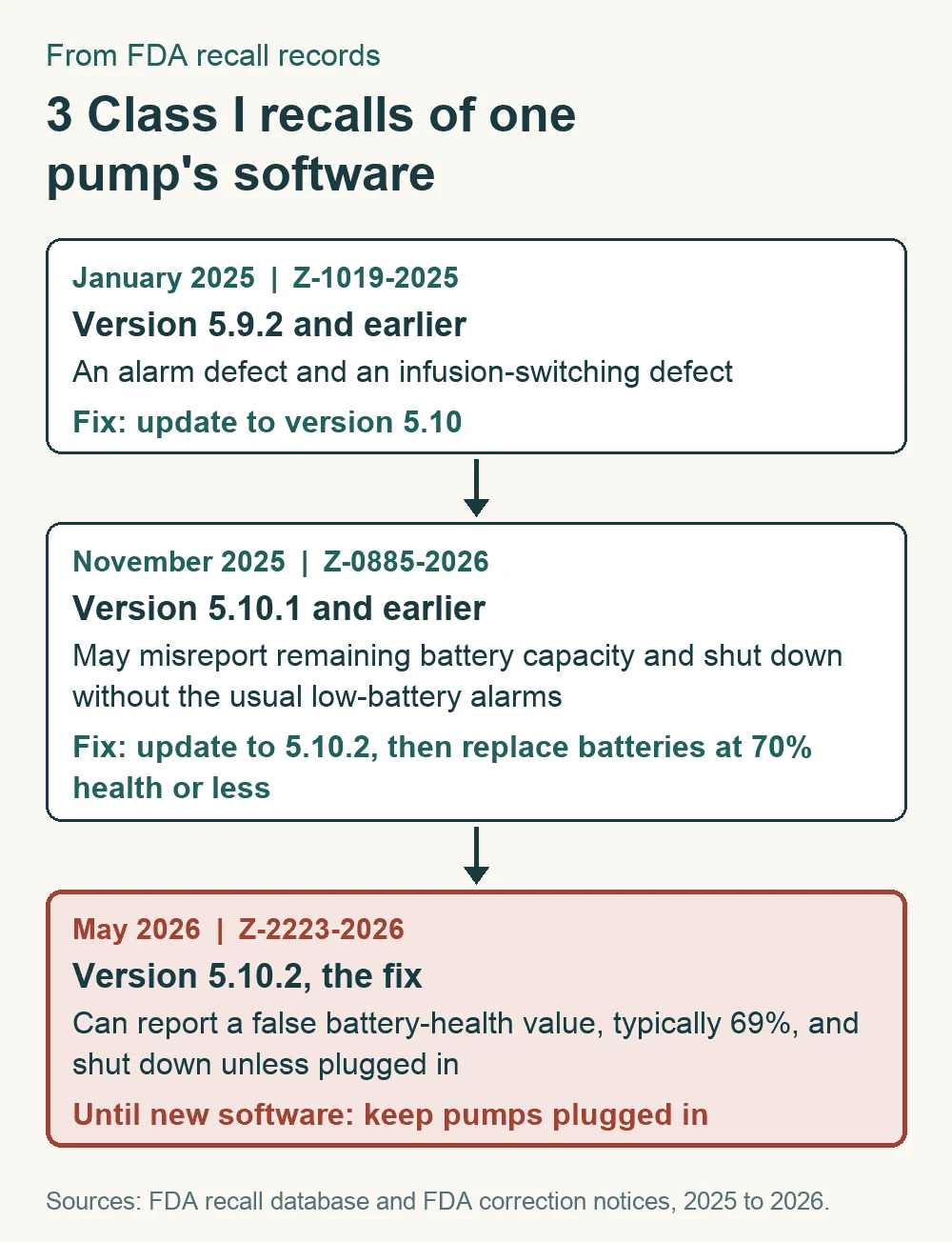
Here is the chain in order:
January 2025, Z-1019-2025. Version 5.9.2 and earlier had 2 defects, one in an alarm and one in switching between 2 infusions. Customers were told to update to version 5.10.
November 2025, Z-0885-2026. This recall covered version 5.10.1 and earlier. FDA's notice says pumps running on battery for long periods "may inaccurately report remaining capacity". The pump could then shut down without its usual low-battery alarms at 30, 15, 5 and 1 minutes left. The notice reported 2 serious injuries and no deaths. The fix was version 5.10.2.
May 2026, Z-2223-2026. This recall covered version 5.10.2 itself. FDA's notice says "This software introduced an anomaly". The pump can report a false battery-health value, "typically 69%". It then raises a battery-depletion alarm and shuts down within 5 minutes unless someone plugs it into mains power. As of April 30, the company reported no serious injuries and no deaths for this issue.
The fix for one recall became the subject of the next. Sources: FDA recall records and notices.
Battery health is the pump's estimate of how worn its batteries are. FDA's notices treat it as a separate reading from the charge left. Until new software is available, FDA says the pumps "should remain plugged in at all times". The notice said that update was expected in July 2026. As of October 2026, FDA's pages do not say that it shipped.
Notice the 69 and the 70
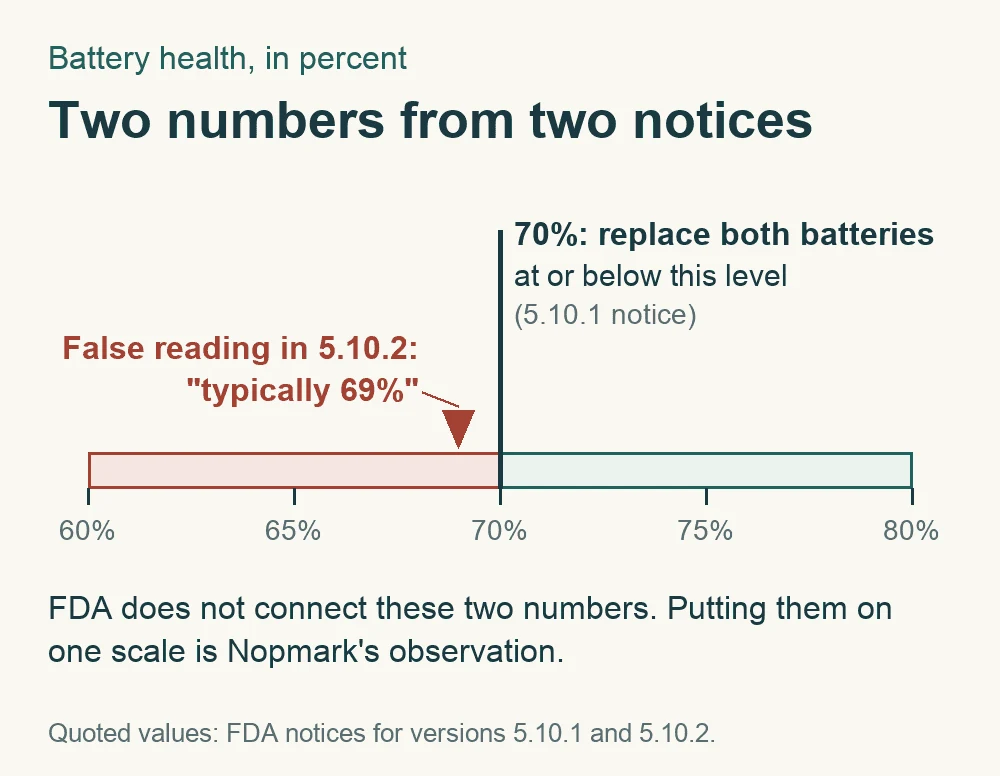
The 5.10.1 notice did more than ask hospitals to update. After the update, it told them: "For pumps identified with a battery health of 70% or less, replace both batteries". It also warned that battery health at 70% or below "can adversely affect performance".
The false value in the 5.10.2 recall is "typically 69%". That is one point below the line hospitals had just been told to use.
FDA quotes both numbers in separate notices. Putting them on one scale is our observation.
FDA does not connect those 2 numbers, and nothing public says the false reading led anyone to replace good batteries. Nothing public says how the defect got into the code either. The link is Nopmark's observation from reading the 2 notices side by side, not a finding by FDA.
It still shows how a fix can change what counts as correct. Before the 5.10.1 notice, 70% may have been one number among many on a status screen. After it, 70% was a value that hospital staff were told to act on. From then on, any release that reports battery health needs to get the readings near 70% right.
A correction is still a software change
FDA calls these actions corrections. Under 21 CFR 806.2(d), a correction is a repair, modification or similar action on a device "without its physical removal from its point of use". The pumps stay in the hospital, and the fix arrives as new software. FDA still counts a correction as a type of recall. Its recall overview says a recall "sometimes means that the medical device needs to be checked, adjusted, or fixed".
Because the device stays in place, a correction can look like a small patch. But the new version is a software change like any other release. It can affect any behavior that shares code or data with the lines that changed.
The ISTQB Foundation Level syllabus splits testing after a change into 2 jobs. Confirmation testing "confirms that an original defect has been successfully fixed". Regression testing "confirms that no adverse consequences have been caused by a change, including a fix that has already been confirmation tested".
Confirmation testing tells you the bug is gone, and regression testing tells you whether the fix broke something else. To decide how far the regression testing should reach, the syllabus calls it "advisable first to perform an impact analysis". Impact analysis is the work of finding which parts of the software a change could affect.
The syllabus files corrective changes and hot fixes under maintenance testing. It says testing a change to a live system includes "checking for possible regressions in parts of the system that remain unchanged". A short change list can make that part easy to skip.
Testing a software fix, worked through
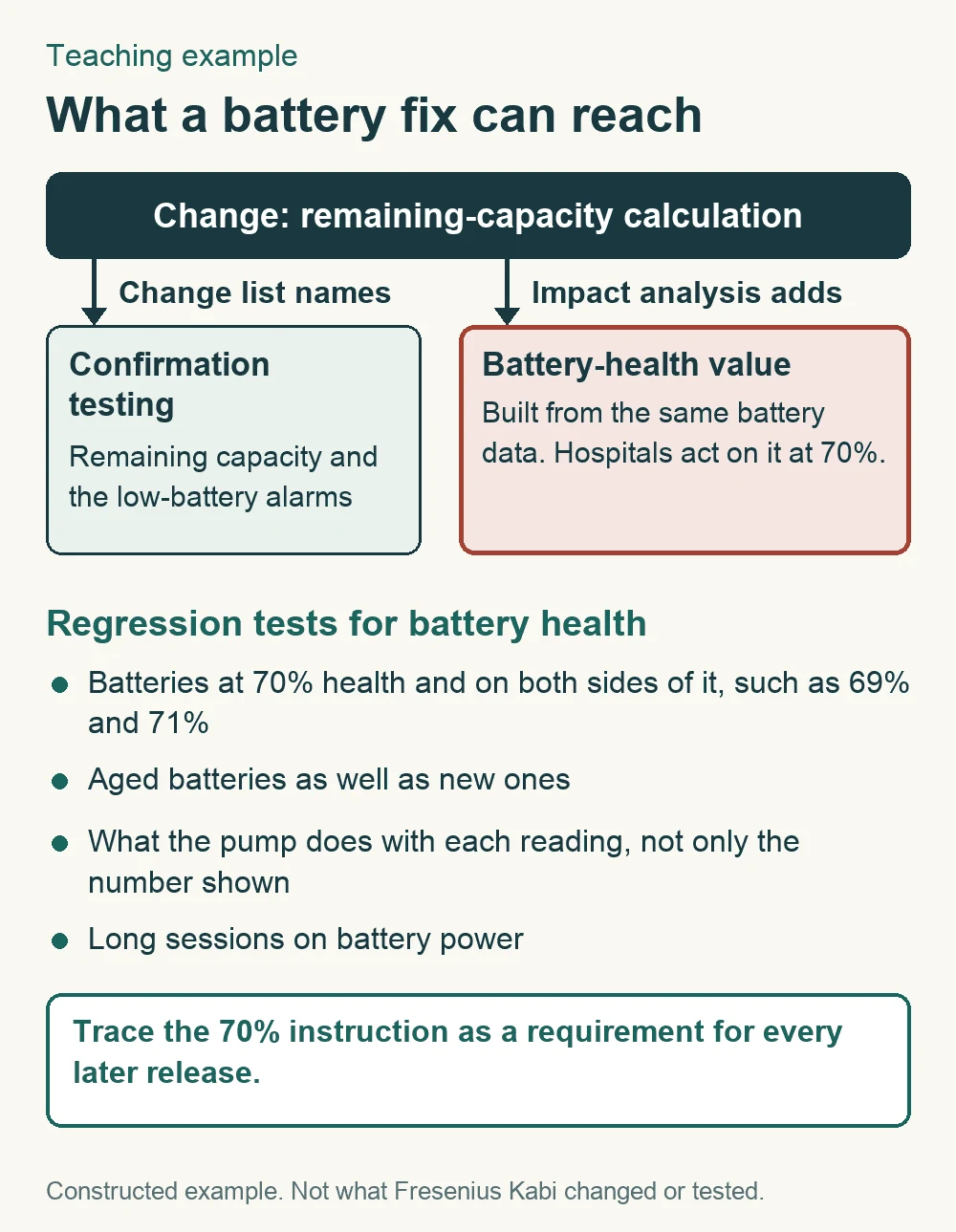
Take a pump team that ships a correction for a battery-capacity defect. The public records do not show what Fresenius Kabi changed or tested, so this team and its code are made up.
The change list names one thing: the calculation of remaining battery capacity. So the team reruns its tests for remaining capacity and for the low-battery alarms at each step. That is the confirmation testing.
Impact analysis asks what else reads the same battery data. In this pump, the battery-health value on the status screen is built from it. And the field notice that ships with the correction tells hospitals to replace batteries at or below 70% health. So battery health is in scope, even though the change list never mentions it.
The regression tests for battery health then look like this:
Use boundary value analysis at the 70% line. Test batteries at 70% health and on both sides of it, such as 69% and 71%.
Repeat those tests on aged batteries as well as new ones. The original defect hit pumps with more battery use, so new batteries alone could hide it.
Check what the pump does with each reading, not only the number on the screen. A healthy battery should never trigger a depletion alarm.
Run long sessions on battery power, since that is when the first defect appeared.
A made-up team and change, not what Fresenius Kabi changed or tested.
The team also adds the 70% instruction to its requirements and traces its tests to it. Hospital staff now act on that number, so every later release that touches battery data needs the same tests.
This is ordinary regression testing with a scope set by impact analysis. The difference is that the boundary values come from the field notice, not the original specification. Nopmark's medical device training bundle includes courses on software validation and risk management for medical devices.
What the test record should show
A reviewer reading the test record for a correction should be able to answer 4 questions without asking the team.
Version tested: the exact software version and build, not "the latest build".
Outputs touched: every output the change can affect. This list comes from the impact analysis, so it includes outputs the change list does not name.
Decision values: each value a field instruction depends on, with the readings tested on each side of it.
Hardware state: whether the tests used aged batteries, new batteries or both.
If the record shows those 4 things, the next team can repeat the tests on the next release. If it shows only that the original bug is gone, nobody can tell whether the readings hospitals act on were ever checked.
Correction, 22 August 2026. This article originally said Edition 2 was in the final stage of standardization with publication targeted for August 2026. Both statements were wrong. Edition 2 is…