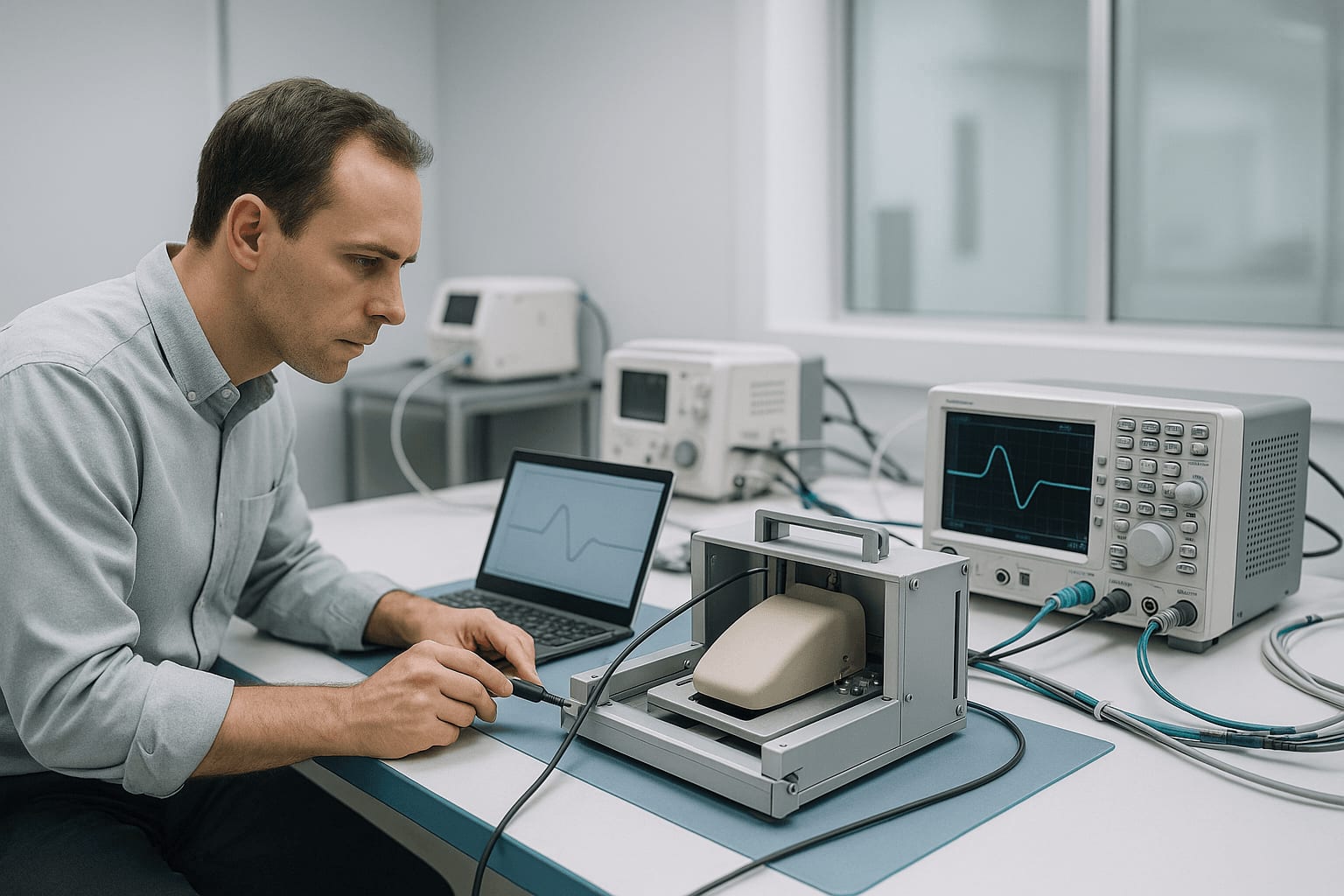
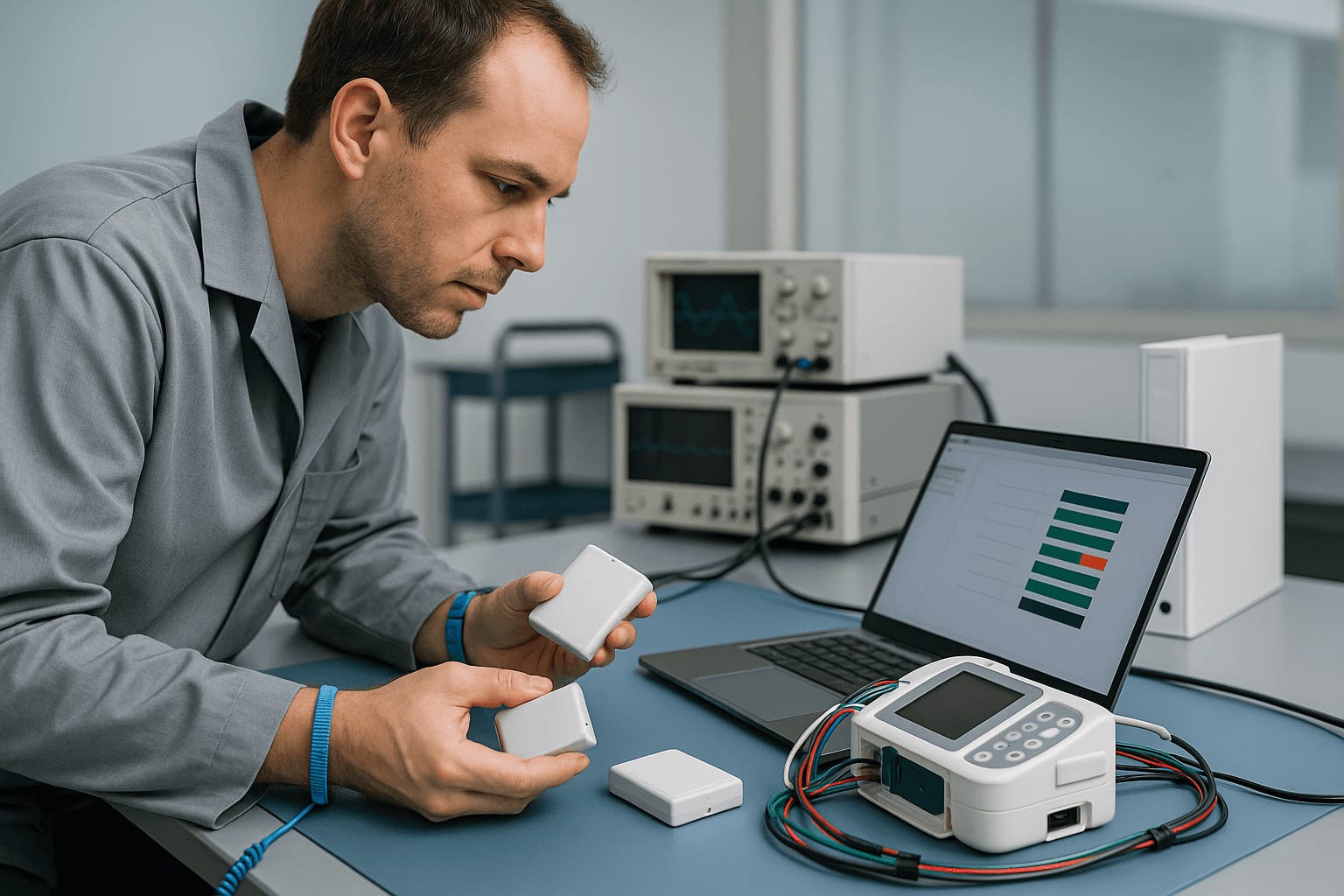
On May 27, 2026, FDA issued a warning letter to Linemaster Switch Corporation, and buried in a list of findings that runs across risk management, rework, corrective action, environmental controls and calibration, there is a software validation citation. The software in question was the program the company used to calibrate and test the device, rather than anything running inside the device itself. Test equipment software validation is the scope most V&V teams have never drawn, and this letter is what the gap looks like when an investigator finds it.
The finding, in the terms FDA used
The software is called the Monitor Program, and it was used in a calibration procedure and quality test procedure, for the calibration and testing of foot pedal accessory devices. It had not been validated for its intended use.
FDA wrote no general observation about inadequate software controls for the medical device product. An investigator asked about the calibration record, and was handed a procedure number and a revision letter. When they asked what validated the monitor program named in that procedure, the company's response was that it planned to validate the software.
The FDA's reply, in summary, was that a plan is not a record: there was no timeline for completion, no protocol, and no documents confirming the work was underway. The agency asked for documentation of a completed, successful validation, for confirmation of when revalidation would be done, and for a determination of whether any additional product disposition was required.
Product disposition is where these questions were driving to. If the program that calibrated your test rig was never shown to do what you assumed it did, then every calibration record it produced is of unknown reliability, and every product release that leaned on those records inherits the unknown accuracy.
Why test equipment software validation stays invisible
So how does a company with a functioning quality system miss this? It happens because of where teams draw the boundary of the word software.
Ask a device team what software validation covers and you will get the device answer. They will name the embedded firmware, the mobile application, the SaMD component, the things IEC 62304 and the QMS governs and the things that appear in the submission. That answer is correct and it is incomplete, and the incompleteness has a root cause: those are the things the design team owns. The calibration program may live in the metrology or service or manufacturing corner. The test fixture script may have been written years ago by someone in manufacturing engineering who has since left. And the spreadsheet that transforms raw measurements into a pass or fail might live on a shared drive.
So who owns that spreadsheet? Who wrote the validation plan that covers it? Which department would you call if an investigator asked to see the evidence behind it this afternoon? On most sites the honest answers are nobody, no one did, and you would spend the afternoon finding out. None of those tools belong to the design history file, so none of them are in the product validation plan, so nobody validates them. But they all produce quality records.
Naveen Agarwal, who published a detailed analysis of this letter on August 7, 2026, makes the connective point about how the agency now reads a quality system. His framing is that FDA examines how failures connect across the entire quality system rather than stopping at individual quality failures. In this letter that connection is visible in the shape of the findings: a missing process FMEA cited under ISO 13485 Clause 7.1 sits alongside the calibration findings, which sit alongside the unvalidated program used to perform the calibration. Those four observations tell one story about a company that could not demonstrate the evidence chain behind its own product release.
The scope rule that actually governs this
FDA published a guidance covering this exact category, and its expectations are lighter than the device-side rules teams tend to apply by reflex.
FDA's Computer Software Assurance guidance for production and quality system software was published in the Federal Register on September 24, 2025. It covers software used as part of production and the quality system. It explicitly does not cover device software functions such as software as a medical device or software in a medical device, which remain governed by the device-side expectations you already work to. And it supersedes Section 6 of the 2002 General Principles of Software Validation, the section titled validation of automated process equipment and quality system software, while the rest of that 2002 guidance still stands.
Two things to pay attention to. The first is that if your software validation SOP still cites Section 6 of the 2002 guidance as its governing reference, it is pointing at a section that has been superseded. That is a five-minute check and I would perform it today.
The second concerns rigor. The CSA guidance endorses a risk-based approach, which means the level of rigor you apply to the Monitor Program sits well below the level you apply to device firmware, and it was always meant to. Teams avoid this category partly because they imagine validating 30 small utilities to a full IEC 62304 standard and conclude they do not have the resources or time. The guidance asks for something smaller. Tailor the effort to what the software does and what happens if it is wrong, and most of these tools resolve into a short, honest record that can take an afternoon.
How to inventory yours
Test equipment software validation starts with an inventory, and the inventory is a much simpler question than the validation itself. You can answer it this week. Walk your quality system and list every piece of software that creates, transforms, transmits or stores a record you would hand to an investigator.
That list usually runs longer than people expect:
- Calibration and metrology programs.
- Test fixture control software and the scripts that drive it.
- Environmental monitoring systems.
- Label printers and their template software.
- The macro-carrying spreadsheet that turns raw test output into a verdict.
- Statistical software used in process validation.
- The electronic quality management system itself, and any integration you built into it.
Then, for each one, answer three questions in writing. What is the intended use of this software in our quality system? If it produced a wrong result and nobody noticed, where would that error end up? And do we hold any evidence that it does what we intend it to do?
Where the answer to the third question is "we have been using it for years and it seems fine", you have found a Linemaster. It is extremely common, and on the evidence of this letter it is also exactly what gets written up.
Where Nopmark fits
The judgment this takes goes beyond knowing that validation is required. You have to set the level of rigor for each item on that inventory and then defend the decision, which is precisely what the CSA guidance asks of you when it says risk-based. Nopmark's Software Validation course covers the scope boundary between device software and quality system software, what a proportionate validation record contains for a small tool, and how to write the intended-use statement that everything else hangs from. It is aimed at the person who has to produce this inventory and then defend it to an investigator.
FAQ
Does this apply to us if we do not make software-driven devices? Yes. Linemaster's finding concerned foot pedal accessory devices, and the software cited was calibration and test software rather than product code. If you calibrate, test, monitor or record anything with a computer, the category applies.
Is a spreadsheet really in scope? If it performs a calculation that determines a pass or a fail, or stores a quality record, treat it as in scope. The rigor should reflect its risk, and it does need a validation record.
What does CSA change about how much documentation we need? It endorses a risk-based approach and supersedes Section 6 of the 2002 General Principles of Software Validation. For low-risk quality system tools that generally means less documentation than teams have historically produced, with the effort concentrated where an incorrect result would actually reach product.
We already told an auditor we plan to validate it. Is that enough? It was not enough here. FDA specifically noted the absence of a timeline, protocols and confirming documents behind the stated plan, and asked for evidence of completed validation instead.
Where do I read the letter myself? It is public, listed as Linemaster Switch Corporation, CMS 730215, dated May 27, 2026, in FDA's warning letter database.
Leave this category alone and the cost lands well past the paperwork: the calibration records go out with an unknown reliability behind them, the product released against those records inherits that doubt, and the question arrives as a warning letter with a product disposition request attached, at which point you are reconstructing years of evidence under a clock. Nopmark's Software Validation course is taught by accredited instructors and works through the risk-based rigor decision on exactly this class of software.