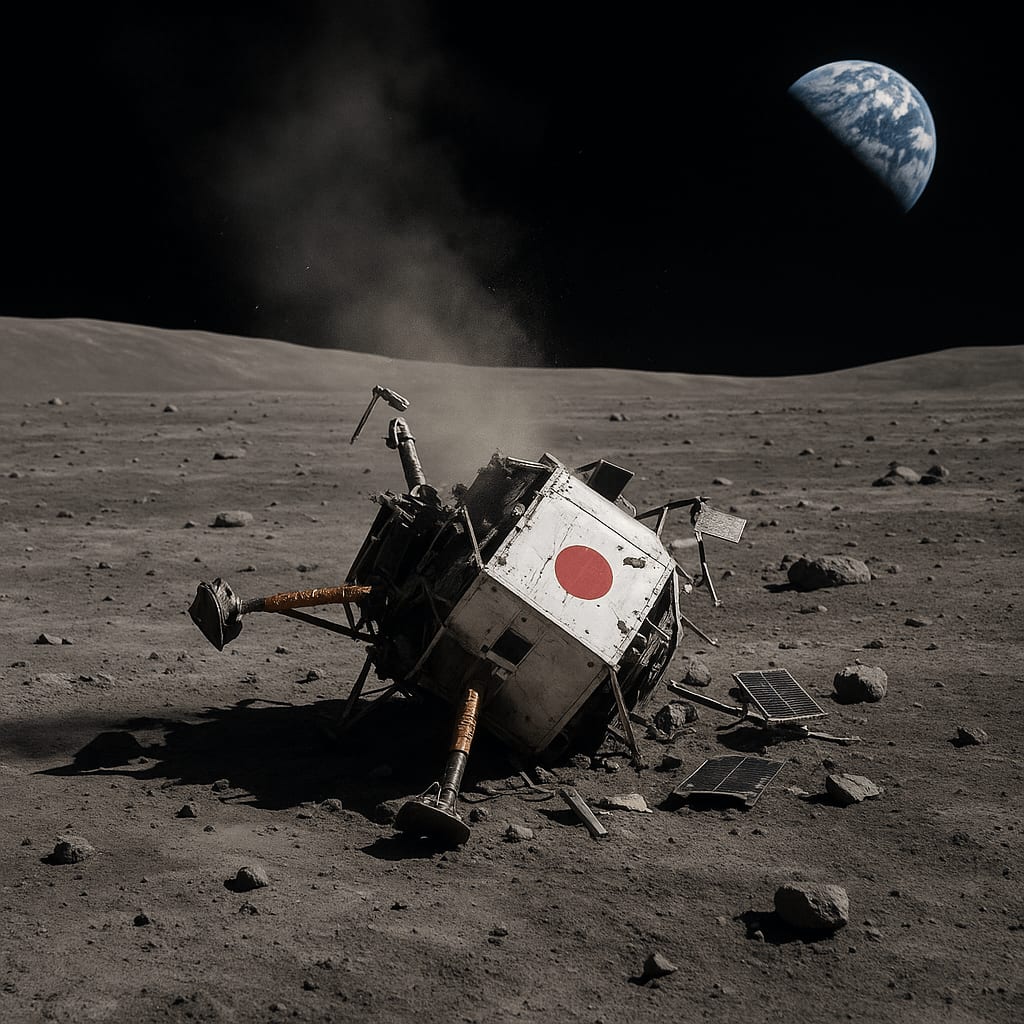
When Software Meets the Moon: A Technical Analysis of the Japanese Lunar Lander Crashes
The Japanese space company ispace has experienced two devastating lunar mission failures in just over two years, both attributed to software-related issues during the critical descent phase. These failures provide valuable insights into the complexities of spacecraft software design and the unforgiving nature of lunar landing operations. For software testing professionals, these incidents underscore the critical importance of robust validation, redundant systems, and comprehensive edge-case testing in mission-critical applications.
Lunar lander software architecture diagram showing critical components and their interactions during descent phase.
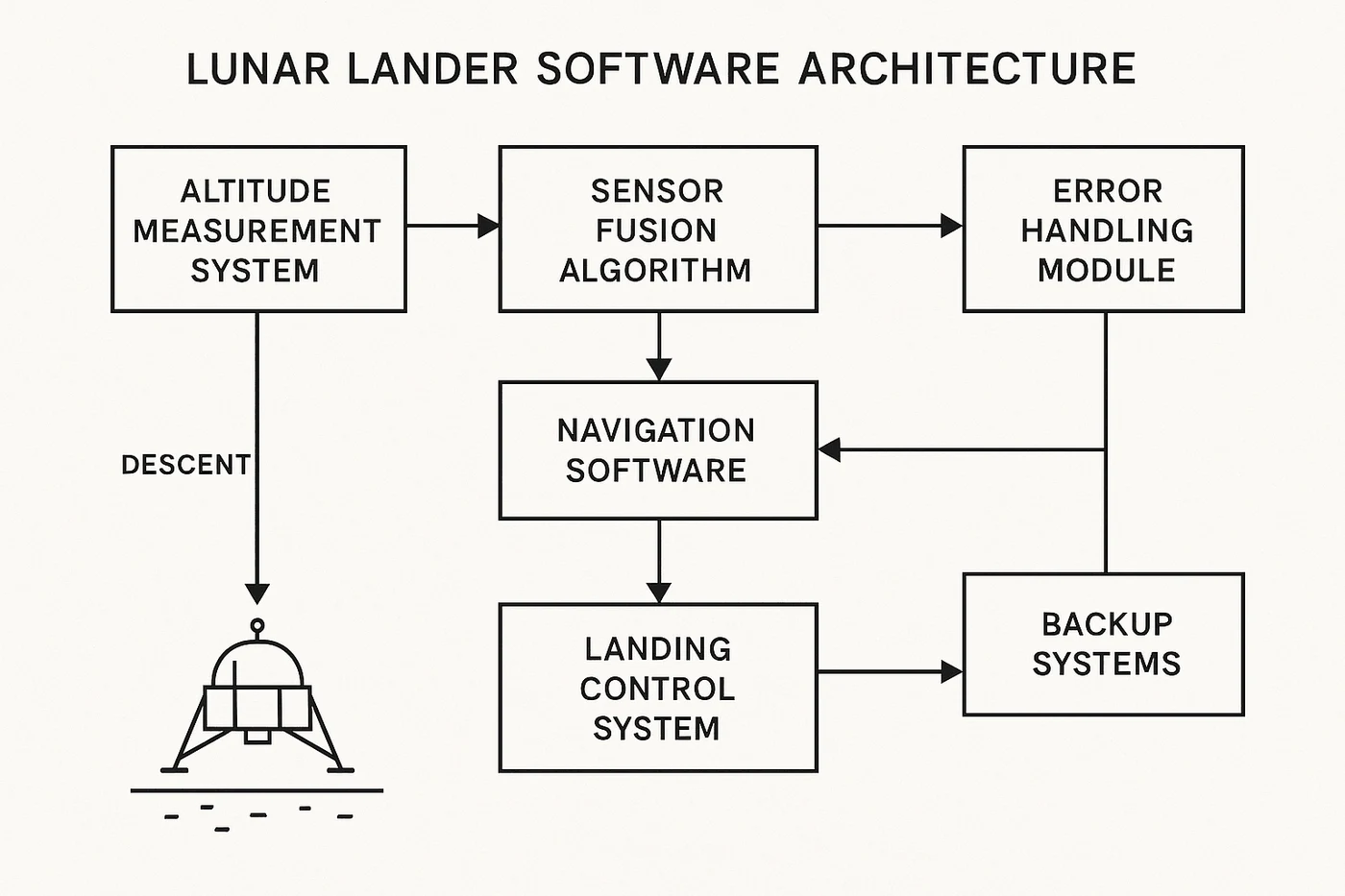
Lunar lander software architecture diagram showing critical components and their interactions during descent phase
Mission Overview
ispace's HAKUTO-R missions represented ambitious attempts to establish Japan as a leader in commercial lunar exploration. Mission 1 (April 2023) and Mission 2 (June 2025) both aimed to demonstrate soft-landing capabilities on the lunar surface, carrying scientific payloads and rover. Both missions successfully reached lunar orbit and initiated their descent sequences before encountering fatal software failures in the final phases of landing, highlighting the extreme difficulty of the "seven minutes of terror" that characterizes powered descent to the lunar surface.
Software Architecture Analysis
The architecture of spacecraft landing systems represents a complex integration of multiple software components working in concert to achieve a successful touchdown. Analysis of the ispace failures reveals significant weaknesses in several critical areas of the software design.
Core System Components
The ispace landers relied on several interconnected software systems critical to mission success. The altitude measurement system formed the primary sensory input for landing calculations, utilizing radar altimeters in Mission 1 and laser rangefinders in Mission 2. The sensor fusion algorithm was responsible for integrating multiple data sources to create a coherent picture of the lander's position and orientation relative to the lunar surface.
The navigation software provided trajectory calculations and guidance commands, while the landing control systemmanaged the complex process of powered descent, including engine throttling and attitude control. Perhaps most critically, the error handling module was designed to manage anomalous sensor readings and system failures. Unfortunately, both missions lacked robust backup systems that could compensate for primary sensor failures.
Architectural Vulnerabilities
Analysis of both failures reveals significant weaknesses in the software architecture. The systems exhibited poor fault tolerance, with single points of failure in critical measurement systems. The sensor fusion algorithms proved inadequate for handling unexpected terrain features or hardware malfunctions. Most concerning was the absence of graceful degradation mechanisms that could maintain operational capability when primary systems failed.
Root Cause Investigation: Mission 1 (April 2023)
The first ispace mission failure provides a textbook example of how software design assumptions can lead to catastrophic outcomes when confronted with unexpected real-world conditions.
The Cliff That Fooled the Computer
Mission 1's failure originated from a fundamental flaw in the altitude estimation software's handling of unexpected terrain features. During descent, the lander encountered a massive cliff approximately 3,000 meters high. The radar altimeter correctly detected this dramatic change in ground elevation, reporting a sudden increase in altitude readings.
However, the onboard software interpreted this valid sensor data as a malfunction. The algorithm had been programmed with assumptions about lunar terrain that did not account for such dramatic elevation changes. When the sensor readings deviated significantly from expected values, the software made a catastrophic decision: it discarded the "faulty" sensor data and switched to inertial navigation only.
The Fatal Logic Error
This decision created a cascade of errors. Operating on inertial navigation alone, the software calculated that the lander had reached the lunar surface when it was actually approximately 5 kilometers above ground. The landing sequence completed as programmed, with engines shutting down and the lander believing it had successfully touched down. In reality, the spacecraft continued its descent until fuel exhaustion, followed by an uncontrolled free fall to the surface.
The post-failure analysis revealed that the software performed exactly as designed – the problem lay in the design assumptions themselves. The developers had not adequately considered the possibility of encountering significant terrain variations during the approach to the designated landing site.
Root Cause Investigation: Mission 2 (June 2025)
Despite the lessons learned from the first mission failure, ispace's second attempt at lunar landing encountered a different but equally fatal software-related issue.
Laser Rangefinder Delays
Mission 2's failure mechanism differed significantly from its predecessor, suggesting that while ispace had addressed some issues from Mission 1, new vulnerabilities emerged. The critical failure occurred when the laser rangefinder system experienced delays in obtaining valid measurement values during the descent phase.
Unlike Mission 1's algorithmic interpretation error, Mission 2's failure appeared to be a hardware-software integration issue. The laser rangefinder, which had replaced the radar system from Mission 1, failed to provide timely distance measurements to the lunar surface. This delay prevented the landing control system from making necessary adjustments to the descent trajectory.
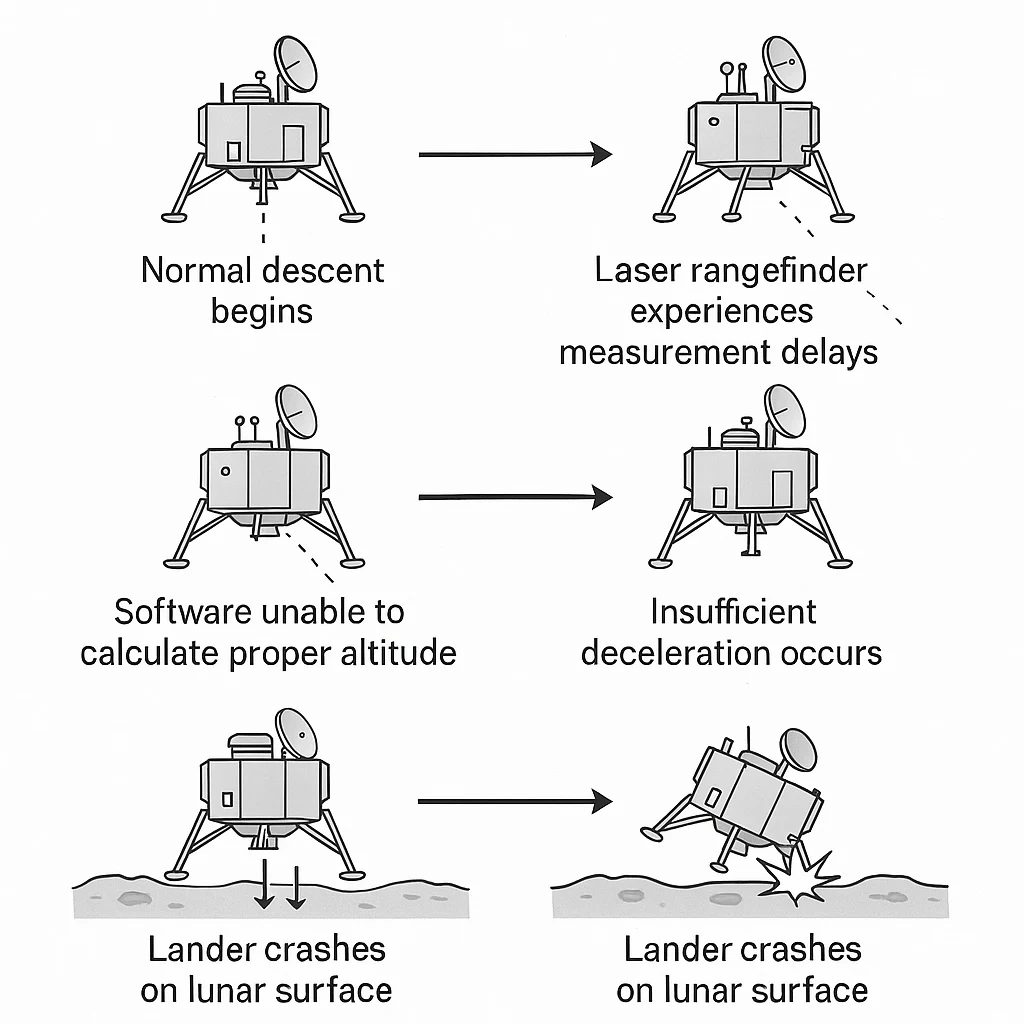
Failure sequence diagram of the Japanese lunar lander crash showing the cascade of events from sensor failure to impact
Insufficient Deceleration
Without accurate, real-time altitude data, the lander was unable to decelerate sufficiently to reach the required speed for a safe landing. Telemetry indicated that communication was lost when the spacecraft was just 192 meters above the surface, descending at a velocity far exceeding safe landing parameters.
The failure demonstrated that while changing the sensor technology (from radar to laser) may have addressed some concerns from Mission 1, it introduced new failure modes that were not adequately tested or mitigated.
Failure Timeline with Critical Decision Points
Understanding the sequence of events in both mission failures provides crucial insights into how rapidly software errors can cascade into unrecoverable situations.
Mission 1 Critical Timeline
00:40 JST: Descent sequence initiated from 100km altitude
~01:30 JST: Lander encounters cliff, altitude readings spike
~01:31 JST: Software determines sensor readings are erroneous
~01:32 JST: Critical decision: Switch to inertial navigation only
01:43 JST: Scheduled landing time, engines shut down at ~5km altitude
~01:45 JST: Fuel exhaustion, uncontrolled descent begins
~01:47 JST: Impact with lunar surface
Mission 2 Critical Timeline
15:13 JST: Descent sequence initiated from 100km altitude
~16:15 JST: Laser rangefinder begins experiencing measurement delays
~16:16 JST: Landing control system struggles with incomplete altitude data
16:17 JST: Communication lost at 192m altitude, excessive descent rate
~16:18 JST: Impact with lunar surface
Both timelines reveal how quickly cascade failures can occur in spacecraft systems, with critical decision points occurring within minutes or even seconds.
Lessons for Spacecraft Software Design and Software Testing
The ispace failures offer valuable lessons for improving spacecraft software reliability, particularly for mission-critical landing systems.
Robust Sensor Fusion Architecture
The ispace failures demonstrate the critical need for sophisticated sensor fusion systems that can handle conflicting or anomalous data without catastrophic failure. Modern spacecraft should implement multiple independent measurement systems with weighted averaging algorithms that can compensate for individual sensor failures.
Comprehensive Terrain Modeling
Software validation must include extensive terrain modeling that accounts for the full range of possible landing site conditions. The Mission 1 failure specifically highlighted the danger of making assumptions about terrain features during the design phase. Future missions should incorporate high-resolution topographical data into their validation testing.
Graceful Degradation Protocols
Both missions failed catastrophically when primary systems encountered problems. Software design should prioritize graceful degradation, allowing systems to continue operating at reduced capability rather than complete failure. This includes implementing multiple levels of backup systems and alternative operational modes.
Real-Time Validation Systems
The software should include real-time validation of sensor data using multiple independent sources. Rather than simply discarding apparently erroneous readings, the system should seek confirmation from alternative sensors or use predictive modeling to validate unexpected data.
Future Mitigation Strategies
Preventing similar failures in future lunar missions will require fundamental changes to how spacecraft software is designed, tested, and validated.
Multi-Modal Sensor Arrays
Future lunar landers should incorporate diverse sensor technologies working in parallel. Combinations of radar altimeters, laser rangefinders, optical sensors, and inertial measurement units can provide redundant altitude and position information. No single sensor type should be capable of causing mission failure.
AI-Enhanced Terrain Recognition
Machine learning algorithms trained on comprehensive lunar terrain databases could provide real-time terrain classification and hazard avoidance. These systems could distinguish between genuine terrain features and sensor malfunctions, preventing the type of error that doomed Mission 1.
Improved Testing Methodologies
Software validation must include extensive simulation of edge cases and failure scenarios. This includes testing with unexpected terrain features, sensor malfunctions, and various combinations of system failures. The testing regime should specifically include scenarios where primary and backup systems fail simultaneously.
Standardized Software Development Processes
Adoption of rigorous software development standards, such as those outlined in JAXA's software development guidelines, can help prevent common failure modes. These standards emphasize comprehensive testing, documentation, and validation procedures specifically designed for space applications.
Enhanced Fault Detection and Isolation
Future systems should implement sophisticated fault detection, isolation, and recovery (FDIR) capabilities. These systems should be able to identify failing components, isolate them from the rest of the system, and activate appropriate backup systems without human intervention.
Comparative Analysis with Historical Failures
The ispace failures join a long history of spacecraft software-related accidents that provide valuable lessons for the aerospace community.
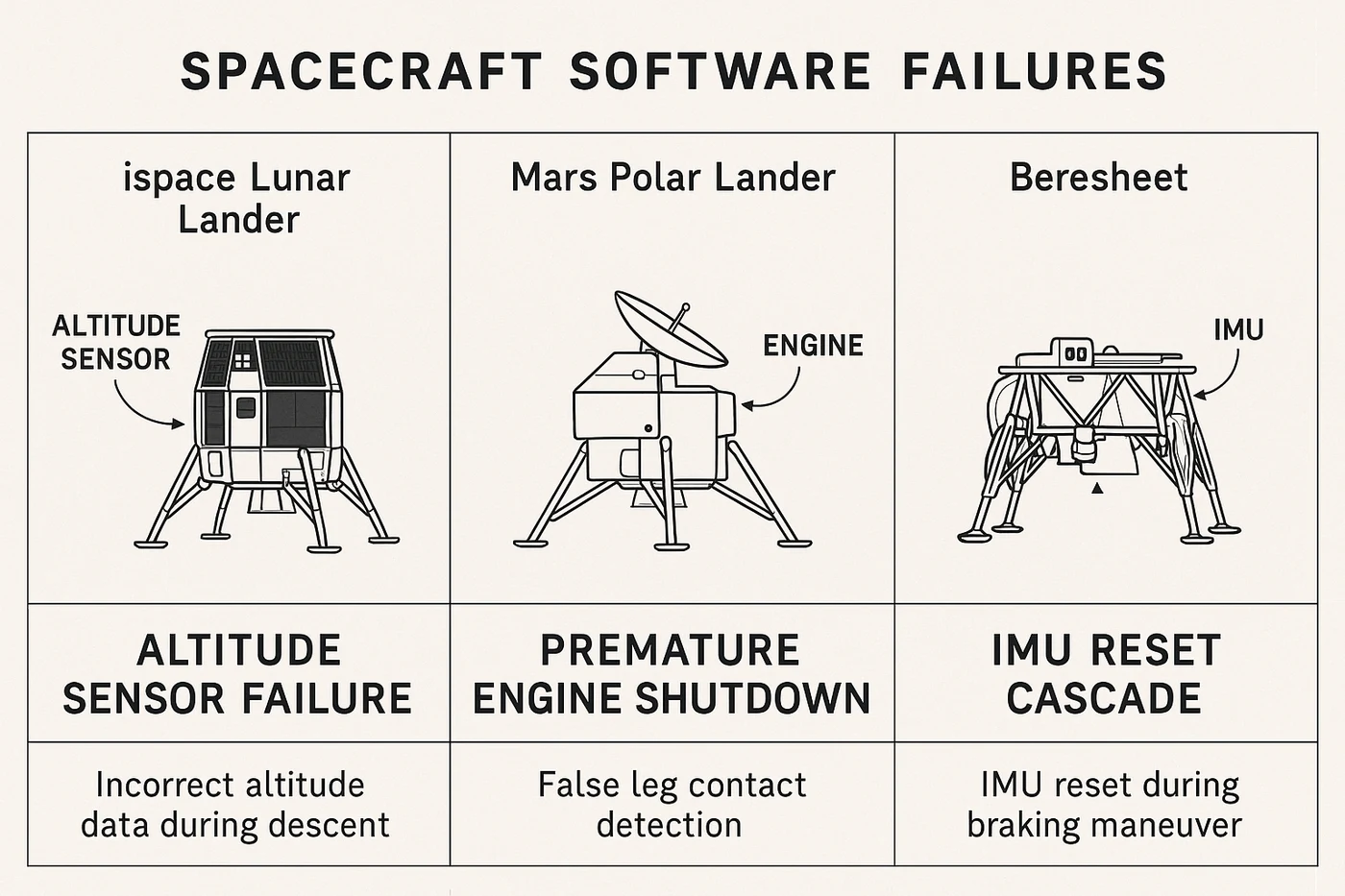
Comparative analysis of three spacecraft software failures showing the specific technical failures in each mission
The Mars Polar Lander (1999) experienced a remarkably similar failure mode, with premature engine shutdown caused by false sensor readings during descent. Like the ispace missions, the Mars Polar Lander's software responded to perceived sensor anomalies in ways that proved catastrophic.
The Beresheet lunar lander (2019) demonstrated another variation of descent-phase software failure, where an attempted reset of malfunctioning inertial measurement units triggered a cascade of system failures. The spacecraft's engines shut down during the critical final phase of landing, preventing successful deceleration.
Perhaps most famously, the Mars Climate Orbiter (1999) failure, while not a descent-phase issue, illustrated the critical importance of end-to-end system validation. A unit conversion error between metric and imperial measurements in ground-based software led to trajectory errors that ultimately destroyed the spacecraft. These historical examples demonstrate that spacecraft software failures often share common characteristics: inadequate handling of sensor anomalies, insufficient backup systems, and poor validation of edge cases. The pattern suggests systematic issues in how the aerospace industry approaches software reliability.