
The Only QA on the Team: Stop Owning Everyone Else's Release Risk
Being the only QA on the team can be an excellent job. You see the whole product and may shape the test approach while the company is still young. But…
You have read this


Each year, the US Bureau of Labor Statistics (BLS) publishes a ten-year forecast for hundreds of jobs. Its software tester job outlook has now fallen in each of the last two releases. In the August 2024 release, BLS expected tester jobs to grow 12% by 2033. The August 2025 release said 10% by 2034. The release on August 27, 2026 says 6% by 2035.
The forecast still says testing will grow, but more slowly, and most recent growth in software development postings is in senior roles.
BLS keeps one page for "software developers, quality assurance analysts, and testers" in its Occupational Outlook Handbook. Testers have their own row on that page, under occupation code 15-1253, so their forecast is separate from the one for developers.
Each release starts from an estimate of how many people held the job in a base year. It then projects how many will hold it ten years later, and the growth figure is the gap between the two. A forecast does not count the jobs that exist today, or the jobs that were lost. BLS also rounds these figures to the nearest 100.
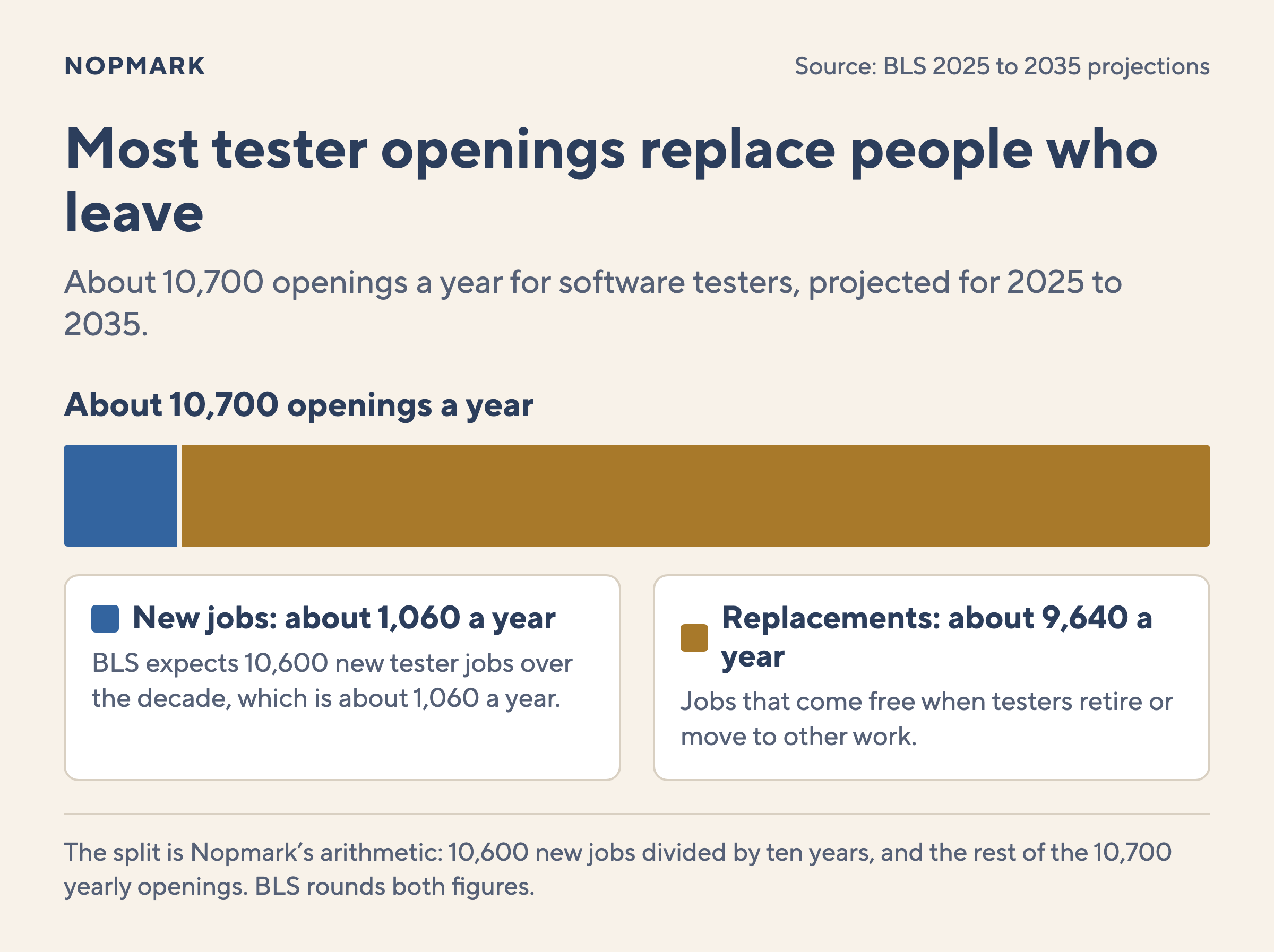
The same page counts openings, which is a different number. Openings include new jobs plus the jobs that come free when people retire or move to other work. The handbook says many openings come from the need "to replace workers who transfer to different occupations or exit the labor force". For testers, the 2025 to 2035 data file lists about 10,700 openings a year.
Put the three releases side by side and the drop is easy to see. These rows are all for software quality assurance analysts and testers.
| BLS release | Jobs in base year | Jobs ten years later | Growth | New jobs over the decade |
|---|---|---|---|---|
| August 2024 | 205,000 (2023) | 229,200 (2033) | 12% | 24,200 |
| August 2025 | 201,700 (2024) | 221,900 (2034) | 10% | 20,200 |
| August 2026 | 187,600 (2025) | 198,200 (2035) | 6% | 10,600 |
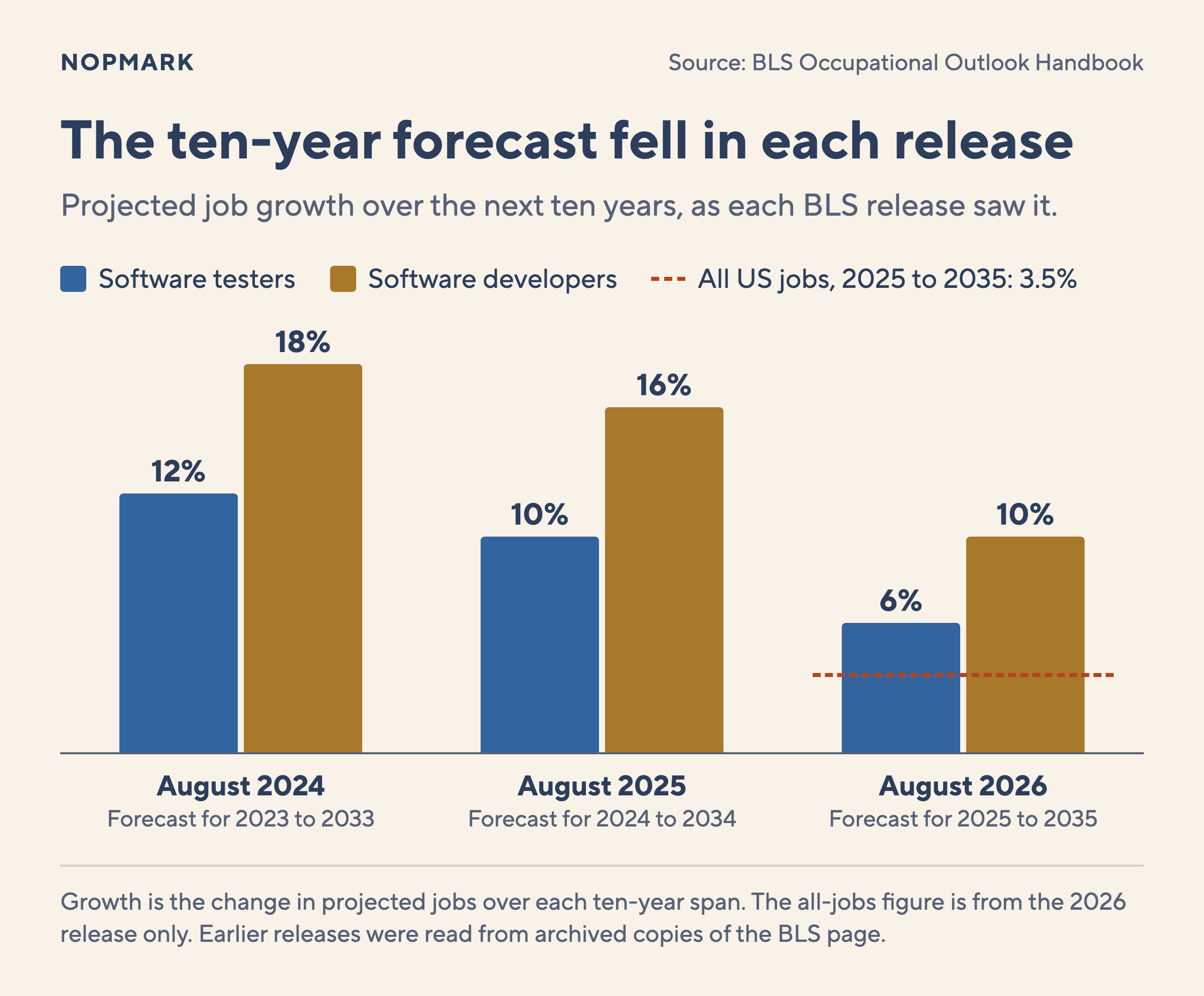
The growth rate fell from 10% to 6% between the last two releases. Over the same step, the number of new jobs BLS expects over the decade roughly halved, from 20,200 to 10,600.
The base-year column also fell, from 205,000 to 187,600, and it needs care. Each release makes its own estimate of the starting point, and the estimates are not built to be subtracted from each other. Reading that column as "17,400 tester jobs disappeared" would go beyond what the data says.
The developer forecast moved the same way, from 18% to 16% to 10% across the same three releases. For all US jobs, the 2026 news release expects growth of 3.5% over the decade. Testing and development are both still forecast to grow faster than the average job.
Back on the handbook page, the written reasons for demand did not change at all. The 2025 and 2026 versions use the same sentence, word for word. Both say demand "is projected to be strong", and both give the same reason: more software being built for AI, connected devices, robotics and other automation.
Both versions also say security work could increase demand for testers "to create and execute software tests". The words stayed the same while the number under them fell from 10% to 6%. BLS does not explain, job by job, why one forecast moved.
Any reason you read online is therefore someone's interpretation, and that includes mine. My reading is that the forecast now expects each tester to cover more software, with help from automation and AI tools. BLS does not say this, so treat it as an instructor's opinion and not as a finding.
The 2026 release added a new table that bears on that question. BLS now sorts jobs into four AI exposure categories: low, moderate, high and very high. Software quality assurance analysts and testers are in the very high group, and so are software developers.
It is easy to read "very high" as "about to be replaced", and BLS warns against that reading. Its page says an exposure category "is not a forecast of employment growth or decline". The data file adds that exposure "does not imply job loss, productivity gains, automation probability, or wage effects". Exposure means AI could be used to help with, or complete, some of the work in the job.
That fits what you may already see at work. AI tools can draft test cases, write test code and summarize a failed run. In my experience, the part that still needs a tester is deciding what to test, judging whether a result is right, and spotting the risk that nobody wrote down. Those are the skills I would build first.
A ten-year forecast moves slowly, but job postings move every week, and Indeed's research team published two updates this month. Indeed does not count testers separately. Every number in this section is for software development as a whole, or for all jobs.
Indeed published its Q3 tech labor market update on November 12. It says every tech category "is up from a year ago, led by software development". It also says all of them "remain well below their early-2020 levels". Its 2027 workplace trends report, published November 18, puts software development postings "down 20% or more from February 2020". Postings are recovering, from a low point.
The same report shows who the recovery is for. It says "71% of the increase in Software Development job postings were for senior roles". It adds that "37% explicitly mentioned AI in their title". Across all jobs, not just software, senior postings were 19.2% above their January 2025 level by September 2026. Entry-level and mid-level postings were each down about 4%.
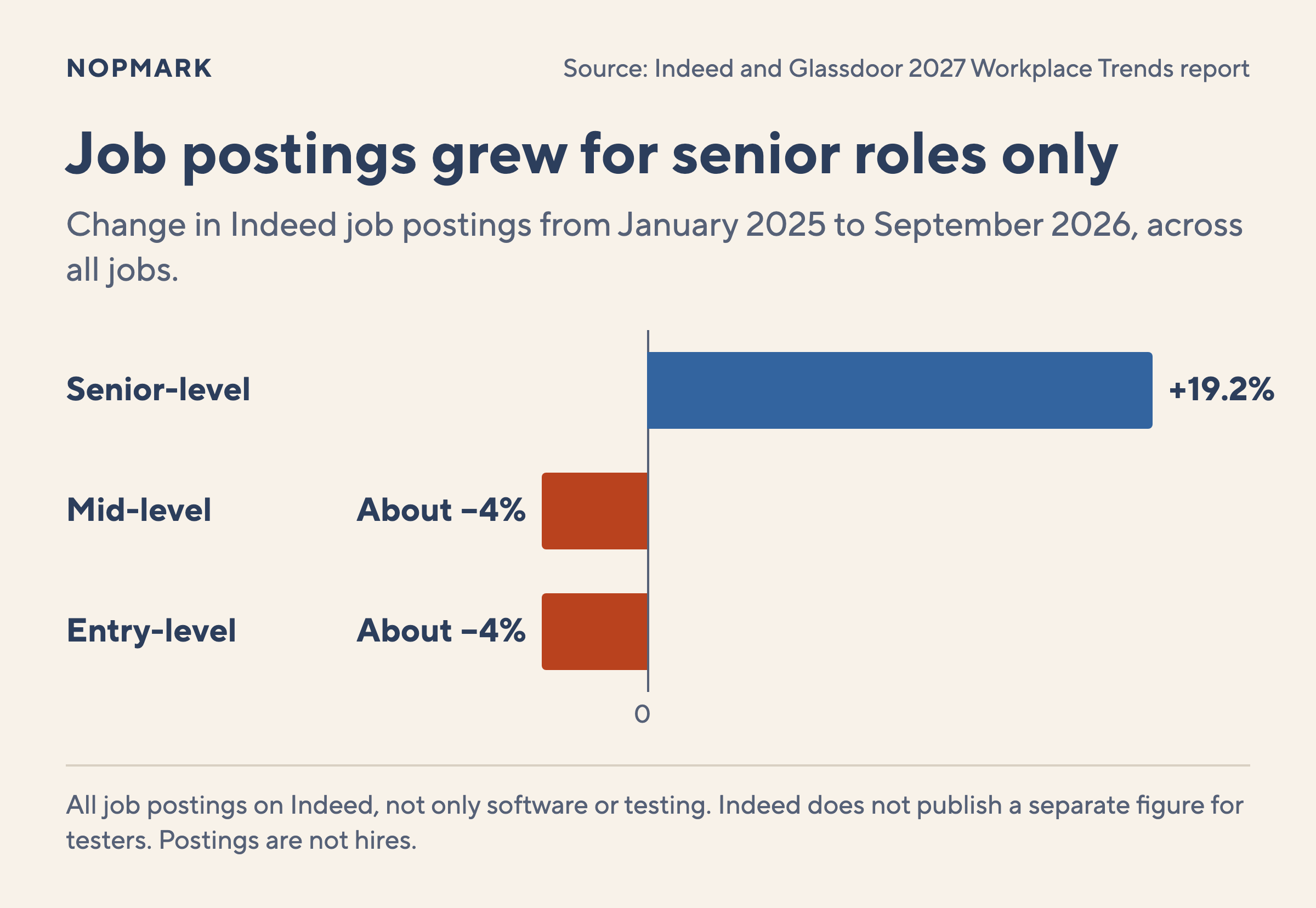
If testing follows the same pattern as development, the hardest step in a testing career right now is likely to be the first job. That is an inference from data that does not split out testers, so hold it loosely.
None of this is a reason to leave testing. The median tester earned $104,300 in May 2025, up from $101,800 in May 2023. BLS still expects about 10,700 openings a year. But a slower, more senior market changes what helps you get hired, and the advice differs by where you are.
Test design and risk-based testing are the core of the ISTQB Certified Tester Foundation Level syllabus. Nopmark's ISTQB CTFL training is available now as a self-paced course. It suits someone getting into testing who wants a structured start, and someone who learned testing on the job and wants to put names and methods to it.
Is software testing a dying career? No. BLS still projects tester jobs to grow 6% from 2025 to 2035, faster than the 3.5% it expects for all jobs. The growth is slower than in the last two forecasts, and fewer new jobs are expected, but it is still growth.
How many software tester jobs open each year? BLS lists about 10,700 openings a year for software quality assurance analysts and testers from 2025 to 2035. Most of them come from people retiring or moving to other jobs, not from new positions.
What do software testers earn in the US? The BLS median for software quality assurance analysts and testers was $104,300 in May 2025. Half earned more than that and half earned less. Pay varies a lot by city and industry.
Will AI replace software testers? BLS rates testing as having very high AI exposure, the same as software development. It also says exposure "is not a forecast of employment growth or decline". AI tools change how testing gets done, and the forecast still expects more testers in 2035 than in 2025.
Is it harder to get an entry-level testing job now? Probably. Indeed's November report shows entry-level postings across all jobs down about 4% since January 2025, while senior postings rose 19.2%. Indeed does not split out testing, so this is a general pattern, not a count of testing jobs.
Being the only QA on the team can be an excellent job. You see the whole product and may shape the test approach while the company is still young. But…
You have read this