
Software Tester Resume: What Gets You the Interview
Many software tester resume pages carry a line like "Responsible for regression testing of web and mobile applications". The line may be true, and it is also very hard to…
You have read this

An API testing practice project can show how you choose tests and diagnose a failure. A reviewer needs enough evidence to follow those decisions.
Kevin Fauver raised a useful career question on Ministry of Testing on September 9. What can personal projects show when production experience with API testing and CI/CD is limited?
A green badge alone leaves the test design hard to assess. It also cannot show how you work with a production team. Fauver's discussion asks about that gap; it does not establish what employers will accept.
Here is a practice exercise you can build locally. The API, rule and fault below are illustrative. No test runs or CI results are reported in this article.
The API lets a user reserve a quantity of places. For this exercise, write down this rule before you write the tests:
A quantity must be a whole number from 1 through 12, including both limits.
Define the response too. In this practice design, a valid request returns HTTP 201 with the saved quantity. An invalid quantity returns HTTP 400 and creates no reservation. Those response choices belong to this example, so tailor them to another API's contract.
Select 0, 1, 12 and 13 for a first set of boundary checks. Work out the expected result from the rule.
| Quantity | Expected response | Expected saved state |
|---|---|---|
| 0 | HTTP 400 | No new reservation |
| 1 | HTTP 201 | Exactly 1 reservation with quantity 1 |
| 12 | HTTP 201 | Exactly 1 reservation with quantity 12 |
| 13 | HTTP 400 | No new reservation |
These cases check the edges of the allowed range. They leave other questions open, including fractions, missing quantities and repeated requests. Record those gaps instead of calling the feature fully tested.
If you need to choose foundation topics to study, try Nopmark's free CTFL assessment. It is a starting point for study, not a certificate of API or CI skill.
Build the intended range check, then create a separate commit with a deliberate mistake. Change the upper check from quantity <= 12 to quantity < 12. Keep the lower-bound and whole-number checks unchanged.
That change excludes 12, even though the rule includes it. The test for 12 should detect the mismatch by expecting HTTP 201. If the faulty API returns HTTP 400, that assertion should fail.
Keep the expected result tied to the rule while you inspect the changed code. A September 8 Ministry of Testing discussion explores how code reading can inform test design. Reading the comparison gives you a reason to test 12. It does not make rejection at 12 the correct outcome.
Run each case with isolated data so an earlier reservation cannot affect your state check. For accepted requests, check the saved quantity as well as the response. For rejected requests, confirm that no new record was saved. A response check alone leaves that behavior untested.
Run the suite on the intended version first. Then run the same tests on the faulty commit and preserve the actual output. Restore the inclusive comparison and run again. Do not change the test to expect the fault.
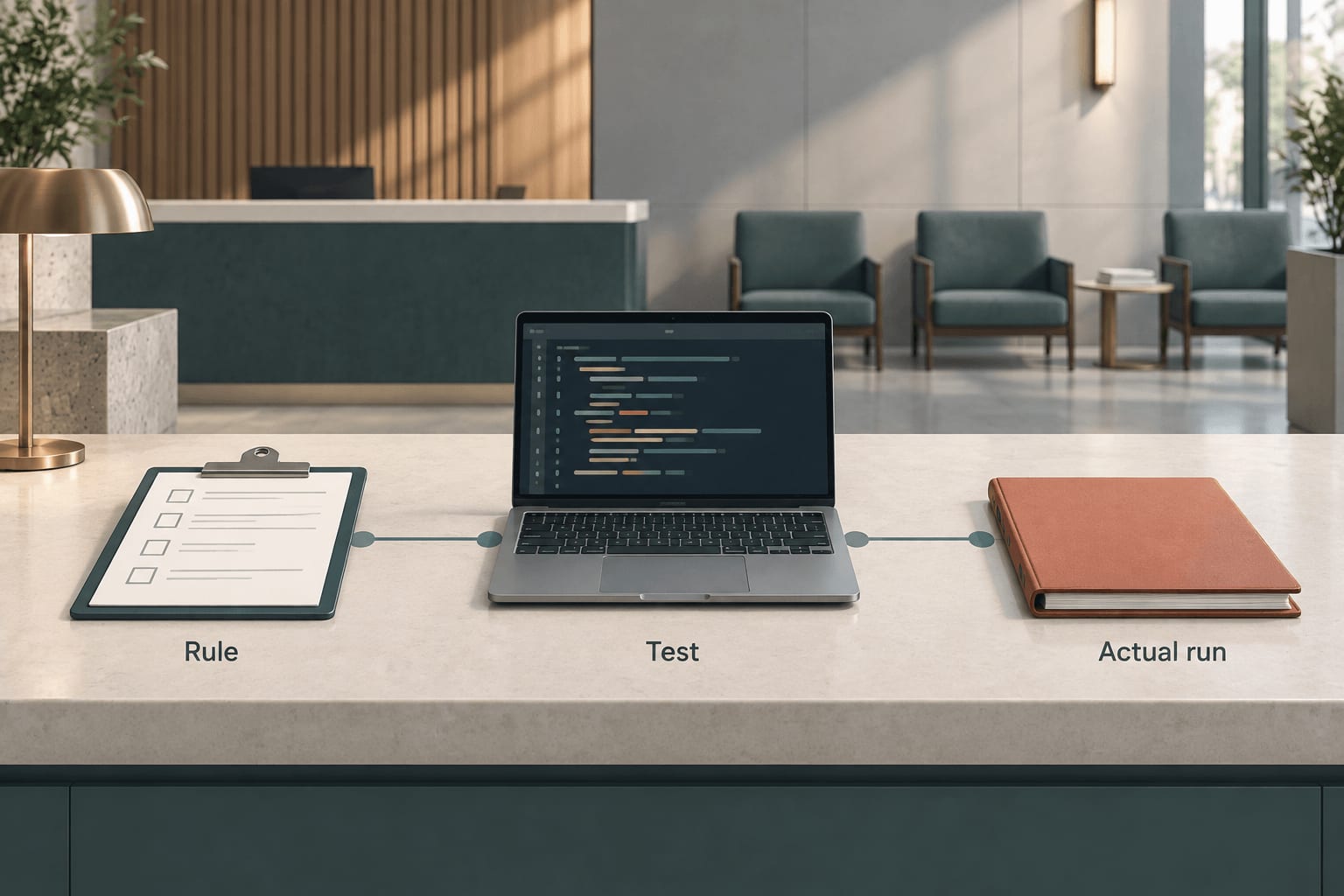
Your project should let a reviewer trace the following evidence:
Use CI to repeat the same command on those commits. Save its job link or exported log only after the job has run. If you have only run the tests locally, describe the evidence as local.
If the faulty version passes, inspect the run before changing anything. Confirm that the test for 12 ran against the intended commit. Check that its assertion still expects acceptance. The failure to detect a known fault is useful evidence about the suite.
A README can say that this is a personal practice project with a deliberately introduced fault. Once you have run it, state which tests detected the fault and link the real output. Explain any checks you could not complete.
That gives a reviewer a way to assess your reasoning and repeat your work. It does not demonstrate production scale, on-call work or delivery with a team. Keep those limits visible when you describe the project in an application or interview.
Start by writing the rule and the expected result at 12. After you run the exercise, preserve the evidence that shows whether your test detected the disagreement.
Many software tester resume pages carry a line like "Responsible for regression testing of web and mobile applications". The line may be true, and it is also very hard to…
You have read this